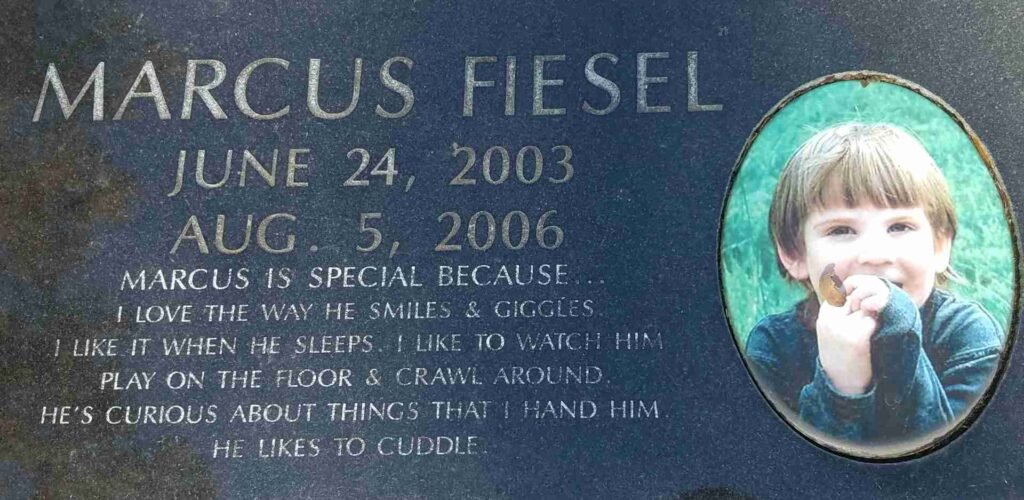
When Marcus Jackson Fiesel was born on June 24, 2003, the third child of his mother, Donna Trevino, it was clear he was a special child. He was “an awesome little guy” commented a neighbor who went on to describe how he loved flowers, bubbles, and Bob the Builder. He was also described as an energetic child, rambunctious – a very typical autistic child.
Sadly, little Marcus never even had a chance to live a good life.
Trevino – The Mother
Donna Trevino was known to have what some would call a complicated relationship with men, often marred with abuse and issues related to substance abuse. Neighbors frequently witnessed Trevino weeping on her front porch due to the sheer exhaustion of trying to manage a boy like Marcus.
Several times, police were called to Donna Trevino’s house, either on a “wellbeing check” or following up on reports of domestic violence. A few of the police reports noted that the house was infected with fleas and smelled of feces. During this time, Trevino came to the attention of Children and Family Services when her ability to properly take care of Marcus came into question.
On September 29, 2005, due to reports of abuse received by child welfare workers, police discovered a large welt on Marcus Fiesel’s buttock. The following January, Marcus crawled out of his bedroom window and subsequently fell off the roof, resulting in cuts to his chin and arm that required stitches. A few moths later, Marcus was discovered walking alone on a busy street where he was nearly hit by a car.
When police arrived with the boy at Trevino’s house, she commented to the officers that she no longer felt that she was capable of properly taking care of the boy, saying that it was “getting to be too much for her”. After that, the child was taken away and the Butler County Job and Family Services was awarded temporary custody.
According to court records, Trevino said that she had no desire to ever seek to regain custody of her son.
Liz and David Carroll and Amy Baker
A couple of weeks after Marcus was removed from his mother’s home, he was placed into the home of Liz and David Carroll and Amy Baker.
On August 15, 2006, Liz Carroll told police that she, Marcus, and three other children (including one that she was babysitting, another foster child, and the biological son she had with David) all went to Julif’s Park. While they were there, Liz claimed that she had blacked out for a few seconds due to low blood pressure. When she regained consciousness, Marcus was nowhere to be found. Soon, a large portion of the population gathered around the park to help look for the boy while even more scattered through the nearby neighborhoods – but unfortunately no traces were ever found.
One week later, Liz Carroll gave a press conference in which she addressed whoever had taken Marcus, begging him to drop him off at any hospital. She went on to comment about the foster care system not always being temporary and how she was “closer than his birth mother to him”.
After the press conference, several people in the community (including ones in law enforcement and in the prosecutor’s office) began to look at the Carrolls with suspicion. Things were just not adding up.
For some, Liz’s demeanor during the press conference seemed off, as if (some commented) she was reading from a script or reciting a well-practiced story.
For others, it was in the details. The story had been a top headline story in all the papers and on the local news for a week – yet, nobody remembered seeing him in the park that day, or any other. There was no evidence found that suggested Marcus had ever been there.
In an interview, Liz claimed that she had only been passed out for a brief moment, no more than thirty or forty-five seconds – and people began to wonder if that was enough time for a young boy to walk off or get taken.
The police were developing their own theory about what happened, and they highly suspected the Carrolls (and possibly Amy Baker) had something to do with the boy’s disappearance. And the more they investigated the trio, the more confusing things had become.
Liz and David Carroll were both given polygraph tests. When word had gotten out that David failed his, Liz was quick to come to his defense saying she knew her husband was innocent and that he would never do anything bad to Marcus.
Perhaps strangest of all were the three people who seemed to be at the center of everything
Liz and David Carroll had been married for some time when Amy began using Liz for daycare while she worked on her GED and went to work. She, or perhaps it was her sister Tonya, noticed a family photo showing David – someone she recognized as someone she had dated when she was fifteen. It is unclear how things progressed from here, however it wouldn’t be long before Liz and David welcomed Amy into their house – the three of them entering into some kind of sexual and financial arrangement. David would claim that Liz was his wife, Amy his girlfriend. Liz would claim the three were, essentially, a threesome although she was adamant that she would not allow David to be intimate with Amy if she were not there. She also admitted to participating in a sexual relationship with Amy even when David was not around.
What the police failed to obtain was any proof that any of them had been involved, no matter how strongly they believed Baker and the Carrolls were guilty. There was also no evidence pointing to where Marcus could have gone or what happened to him. They appeared to be at a dead end.
There was, however, one small thing they had not followed up on – one small possible clue that they felt was inconsequential. Just prior to Marcus’ disappearance, they had traveled to Kentucky for some sort of family reunion. Yet, the police never followed up on this statement. With no other leads to follow, they sent an investigator down to ask some questions.
What they learned from this was that yes, Liz and David had attended a family reunion. While they did show up with their other children, Marcus was not with them. This led investigators to speculate that perhaps whatever happened to Marcus occurred a lot earlier than they had previously thought.
Confessions And Things
The prosecutor’s office convened a grand jury and subpoenaed Liz Carroll, David Carroll, and Amy Baker to testify. David was unable to be located to be served and did not attend. Liz was the first to arrive and nearly instantly displayed a temper. When asked if she had hired an attorney, she commented, ‘I don’t need an attorney. Seriously, bring it on, big boy. You want to question me like the police did? I’m fine. I’ll tell you what happened.”. She would face questions alone.
Amy Baker was another story. She was appointed an attorney, however as she had no legal obligations to Marcus Fiesel (she wasn’t his parent or foster parent) prosecutors, through her attorney, offered her immunity if she would testify against the Carrolls. Amy met with her lawyer and over an hour later, she agreed to tell prosecutors everything, but only if the immunity offer was still valid. Prosecutors said that if she didn’t hurt Marcus, and she told the truth – the deal was good.
According to the story Amy told, the Carrolls did attend the family reunion, however they did not want to take Marcus with them on account of his rambunctious nature.
“They rolled him in a blanket with his arms at his side. Took packing tape and wrapped the blanket around him, so only his head was sticking out. Put him in a playpen, shut the closet door, and left. Amy said they could hear him screaming upstairs when they left,” the lawyer reported.
When they returned, either two or three days later, they discovered Marcus dead.
Liz Carroll was next to face the grand jury. She began to recite the story she had been telling but was interrupted by the prosecutor who laid out what Amy had just told them and asked if it was true. At first, she was unready to comment – but the prosecutor gave her a possible out. He asked if Marcus’ death was an accident … Liz thought for a moment before changing her story. Yes, she said, Marcus’ death was an accident.
Liz stated that when they came home from the family reunion and found Marcus was dead, they took his body to an abandoned chimney in Brown County and incinerated his remains. After then, they spread most of his ashes in the Ohio River.
Proper charges were filed against Liz and David. Liz was ultimately convicted and sentenced to between 45 and 65 years behind bars. After this, David took a plea bargain, accepting a fifteen-to-life sentence of his own.
In a controversial move, no charges were filed against Amy Baker. She would be arrested on unrelated charges and has spent more time between bars between then and now than she saw any freedom.
Let’s Back Up A Second…
As more and more facts in this case became known and especially during the criminal trials – one question seemed to be on a lot of people’s minds: How could this have happened in the first place.
Foster children are often described as “invisible” children, unwanted by some, forgotten by others.
It seems like everyone knew that the foster care system was broken. What nobody could agree on was whose fault that was, who was responsible to fix it, and what exactly needed to be done.
In other words – it was a complicated mess.
Some blamed Job and Family Services, others agencies like the one that placed Marcus into the Carrolls care. Yet, they could only follow laws and regulations that were already in place. The Carrolls appeared to be working within the established system, so there was nothing the agencies could do, even if they were aware of everything that was going on.
These agencies also have a very high turnover rate for employees. Often, employees find themselves with exceptionally high workloads, taking on more cases than even seasoned employees can handle. These agencies do not have a large enough budget to hire as many workers as needed – the high stress nature of the job also plays into employee morale as feelings of being overwhelmed become common. How are these agencies supposed to operate without being granted the resources needed?
Let’s look at one fact that I have, so far, not mentioned. Several weeks before Marcus’ death, police were called to the Carroll house and David was arrested and charged with domestic violence. Several days later, at the prompting of Liz, those charges were dropped. At the time, David Carroll was required to report the arrest to either Job and Family Services, or to his social worker at the foster care agency – which he failed to do. Some would even question why anyone would self-report in those circumstances, as they would have nothing to gain and everything to lose by doing so. Law enforcement agencies were not required to report either, perhaps because it was not their job to do so.
The social worker was never given this information and therefore could not follow up.
It has also been noted that the social worker had not seen Marcus on several of her welfare checkups. Liz would claim that after an energetic morning, the special needs child had just fallen asleep and she didn’t want to wake him. On other visits, he was spending the day with her (or David’s) mother. Whatever the case, the social worker was assured by Liz that everything was fine, and without any major hints to the contrary, the overworked social worker took her word for it.
After the events of this story was over, a lot of attention has been paid to both the Carrols, and Amy Baker and some curious things have pointed out.
For example, the Carrolls’ financial situation. Liz was unemployed, instead preferring to stay at home and raise the foster children. In and of itself, there is nothing wrong with this. However, David spent long periods unemployed. He would get a job, like working for Rent-A-Center, but a few weeks later he would be back on the job hunt once again. Liz would gain some income babysitting (which was the catalyst that brought Amy back into their lives) although it is unclear how much she earned doing this.
Some have questioned why, with such limited financial resources, were the Carrolls qualified to foster multiple children?
During trial, it was revealed that she (and Amy) was scamming the system. When Amy first started having Liz watch her children, a welfare program would pay Liz a standard fee, but Amy would also be required to pay a small co-pay. When Amy got a new job, the co-pay amount went up – which Amy did not think was fair. Liz concocted a scheme where Amy would not have to pay any co-pay at all – as long as she would sign off on babysitting hours that did not take place, therefore getting the welfare program to give Liz more money that they believed more than made up for the co-payment amount. Both ladies seemed more than thrilled with this fraud.
Now, it is easy to point the finger of blame at both Carrolls as well as Amy Baker – and for sure the bulk of this scam rests solely on their shoulders. Yet, the foster care system was supposedly designed to protect children, so shouldn’t there have been something in place that would have caught the fraud if not prevented it from happening in the first place.
The more I have looked into this story – the stranger it has become. It is also hard to know what is true and what is not – since much of it relies on things Liz and David Carroll (as well as Amy Baker) have said and all three of them have admitted to and perpetrated scams, and their history with honesty is questionable at best.
As this story was making its way through the evening news and daily newspapers, there was something about Marcus Fiesel that grabbed public attention. Every story would be accompanied by Marcus’ smiling face, a cute but sinister reminder of a child, victim of a horrible act of cruelty, an innocent special-needs life that was failed by his mother, the foster care system, and nearly everyone who came into contact with him.
It was hard for the public to look at that boy’s picture and not get enraged. Changes, the public now demanded, needed to be made.
And they were.
Some changes were made at the state level (such as daily background checks for all approved foster parents) while others were further made at the local level. The agency that placed Fiesel with the Carrolls was hit particularly hard, with the agency forced into constant oversight from state authorities. Other similar agencies adopted their own new policies in a proactive step to prevent something like this from ever happening again.
None of these changes fixed the entire system, but it was a major step in improving the lives of the most vulnerable children.
Today, the Foster Care system (and Job and Family Services) is still far from a perfect system and many argue that something needs to be done, still. Yet, once again, we seem to be at odds with whose fault it is, whose job it is to fix it – and what that solution ultimately is. And, to me, that sounds an awful lot like where we were when this story started.