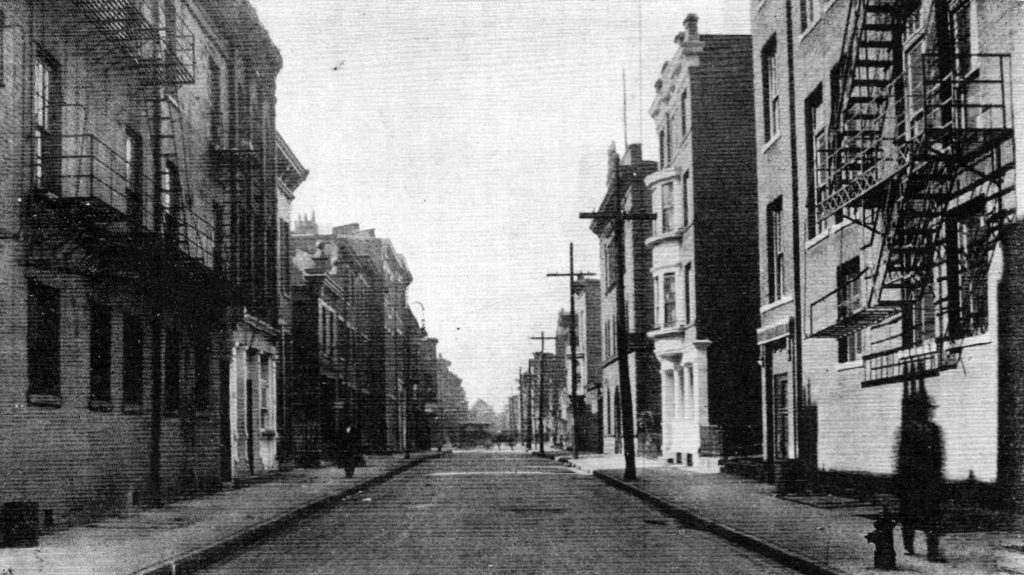
Today, George Street in Cincinnati doesn’t seem very notable. It is only a block long, and other than some brick walls, you won’t see much. The only real exception being a few trees and benches at the rear entrance of the Cincinnati Bell building.
I would bet that most people who live in Cincinnati probably have never set foot on George Street and would most likely need assistance finding it on a map. (It’s between 6th and 7th street and connects Plum and Elm streets.)
This was not always the case.
If you could go back in time, you would discover that a bit longer George Street was bustling with … er … activity. At least at night, where You’d see people walking between the various establishments, like going from the (questionable) poker hall across the street to the dimly lit brothel for a more intimate form of entertainment.
By all accounts, Cincinnati’s George Street was the heart of the Tenderloin District. People said that whatever kind of excitement you were looking for, you could find it there.
Therefore, it is clear why history might not want to remember George Street.
What I want to know is … was George Street always like that? Is there anything that is worth remembering? The answers I found … were kind of surprising.
The notorious stretch of George Street ran from Plum and went four blocks west to Mound Street. (At one time, that four block stretch was home to 46 brothels.) Today, the majority of where that road is today would be beneath the odd spaghetti-like strand of streets that were formed between I-75 and the 6th and 7th street ramps and the preparation for the junction for I-71. (Seriously, who designed this mess?)
It kind of made me wonder if the city tried to erase the red-light district by designing a massive highway exchange over the whole thing? The answer … is complicated. I don’t think so. If anything, it only played a small part. But, first, let’s look at the history of George Street.
Earliest Mentions
It can be difficult sometimes to write about the history of a person, but a street – that’s even more so. But, to begin, I started searching through old newspapers to see if there was anything there that I could find.
The earliest mention I located was an announcement that the Seventh Ward Democrats were holding a meeting at the Engine House on George Street between Plum and Western Row. (August 1841)
The next reference I found to George Street required a bit more investigation. At the center of this was a German Jewish Rabbi, Raphael Hirsch. He was a fairly well-known, at least among the Jewish German population. In 1854, he began publishing a monthly pamphlet in the Cincinnati area. The printers for this were located on George Street between Elm and Plum. Other ads promoted Jewish butchers and other merchants.
Excuse Me Madam, Do You Run A Brothel?
By the 1890s, George Street appeared to be a unique place, a mixture of semi-wealthy and poverty, educated and non, white and colored. I would like to say that all these Gorups tended to peacefully tolerate each other’s existence, but that might not be accurate. The police were called more and more often to various George Street addresses that they considered the street to be a “nuisance”.
It’s important here to look at things in the correct historical context. Running a brothel, just like prostitution in general, existed in this grey area – it was never a legal business in Ohio, and in the 1830s it was outlawed, however it was permitted in certain areas, such as one particular four block stretch of George Street in Cincinnati.
Some people have pointed out that the police could have, at any time, swept in and closed all the brothels, arrested all the Madams and patrons – anything to clean up the area. There are a few problems with this theory – the largest (to me) being that the situation had quickly grown larger than anything that what passed for police in those days could easily take care of.
The area had already garnered such a reputation that should a brothel close, another would surely open the following day. Customers were more easily replaced – there was always going to be some lonely young man looking for a moment of adult entertainment.
Whatever it was going to take to solve this problem, more than local law enforcement was needed.
By 1893, the “problem” was getting worse. By then the road was known as the place where one could partake in any vice, no matter how depraved their desires were. In some ways, life back then was somewhat “lawless” when compared to today’s mentality, so to get such a reputation back then said something.
Several of the local churches banded together and confronted city officials. What’s notable isn’t that the city failed to do much of anything – it was that it was a coordinated effort between two white churches and one black congregation. Considering the racial mentality of the time, this was kind of a big deal.
In 1893, The Cincinnati Enquirer called this stretch of George Street the “Red Light District”. This is notable for a few historical reasons – first, it was among the first times that “red light district” was used to note a part of town where prostitution was rampant. (Some people like to point out that the Red-Light Saloon in Dodge City, Kansas had been a very well-known brothel for several years at this point – while others suggest the term comes from the myth that Sailors used to take red-colored lanterns when they visited houses of ill repute so that their crew could easily find them if they were needed. This was also a few years before The Red Windmill one of the most well-known brothels that ever existed was first opened – never heard of it? Translate it back to French and it’s Moulin Rouge.)
The other reason this is notable is that, at least on George Street, there was almost a complete lack of “Red Lights”. Rather than use colored lights to determine the type of patrons they wanted to cater to, they instead chose something that was at the time only seen in churches: stained glass windows. These would feature elaborate designs in cut glass, the name of the madame featured in the center.
Cleaning Up The City?
By the Mid-1889s, Cincinnati had developed a reputation that wasn’t exactly the best. Lawlessness had become such a problem that the state had to step in and in 1895, passed an act that all but eliminated the entire Cincinnati police force. The goal was to essentially wipe the slate clean from corruption and vice, then replace it with something new – a Department of Public Safety,
The first Superintendent of this new department was an engineer named Arthur Moore. The problem with him was that he really wanted to be the Superintendent of the Water Works, so when that position became available ten weeks later, he jumped at the new opportunity.
This paved the way for Philip Henry Deitsch, Sr. to become superintendent. Many of the city’s residents turned to him to try and clean up George Street, but he all but refused. Instead, he sat down with the George Street madams and proposed that it would be in everybody’s best interests if they were to move several blocks farther west on George Street.
This did not go over very well with the brothel owners, and when other residents found out about his proposal, they became enraged. There was a brief movement to rename the street, but the council refused to do anything.
Dirty Helen
Helen was born to a well-to-do family from Indiana on February 26, 1886. We don’t know too much about her childhood, but we can assume based on what she was like as an adult, she may have been something of a problem child. When she was still very young, she eloped to Ohio when she got married and settled somewhere in the Cincinnati area.
According to the legend, she discovered that her husband was utilizing the services of one particular lady-of-the-night, which Helen didn’t take too kindly to. She claims that she slashed the girls’ face and breasts in a brutal fashion before flinging her down a flight of steps.
After this, Helen discovered that life without a husband was a bit more difficult than it maybe should have been and she was left with few options. Rather than return to her family life (or, perhaps she couldn’t) she soon found job as a sex worker in a brothel on George Street.
Some tellings of the legend suggest that it was during this time that she developed her outspoken and brash personality as well as her tough attitude that she would go on to be known for, but I would think that anyone who would beat her husband’s sex-worker was already well on her way there.
What there is no question about is that during this period of her life, she learned the brothel trade, in and out. My personal theory here is that based on her personality, she loathed working for a madam more than anything else, couldn’t abide being told what to do – so she learned the trade and before long opened her own brothel.
And so the legend of Dirty Helen’s was born.
Dirty Helen stayed in Cincinnati for a couple of decades, even found a way to open additional locations in other cities. At the ripe old age of “fourty-something” (maybe fifty-something) she relocated to Wisconsin where she stayed for the rest of her life. (Dirty Helen’s stayed open for a brief time afterwords.)
All Good Things Come To An End
For years, it seemed like nothing could curtail the endless vice and debauchery up for sale on George Street. Few people were willing to stand up to the brothel madams, or to the patrons that frequented these establishments. In the early days, the police department tried, although they were soon corrupted. They were replaced with the Department of Public Safety. They seemed more interested in moving the brothels to a less populous part of town than actually trying to shut them down. Beyond that, various politicians including several mayors and members of the new police force tried to leave their mark but that seemed to only make the situation worse.
So, then, what brought all the George Street shenanigans to a close? Well … it was war.
The war in question was World War I and the United States Army had a problem. Yeah, I know they had more than one problem – but the one we’re talking about is VD. Or venereal disease. Or what we refer to today as Sexually Transmitted Diseases.
Otherwise healthy men kept enlisting, but before they could ship out to wherever the Army wanted them to go, they’d find themselves sick with things like chlamydia, gonorrhea, and syphilis. The leaders of the army knew who they wanted to blame – prostitutes.
The Chamberlain-Kahn Act of 1918 started a new federal law which enabled military officers to detain anyone suspected of having a sexually transmitted disease and detaining them for as long as necessary so they could be examined and treated if necessary. This led to the American Plan, in which the Army teamed up with social service organizations and businesses like the YMCA to combat the spread of sexually transmitted diseases.
On an historical note, it’s believed that over 15,000 women in the United States were detained and incarcerated on suspicion of having a sexually transmitted disease, many of whom never got treatment. Many (if not most) of these women were prostitutes (or were suspected of being one). Again, they were not accused of any crimes, never stood in criminal court – yet they were detained for indeterminate periods of time.
One of the main focuses of the Chamberlain-Khan act was to focus on areas around military bases and giving the federal government more options on how to deal with “objectionable” establishments … which appears to be military-speak for “brothels”. While Cincinnati did not have a military base near George Street, Fort Thomas did lie just across the river in Northern Kentucky and in the eyes of the Federal Government, that was close enough.
It wouldn’t take terribly long for the military to force the closure of the brothels, especially if they could whisk anyone to worked in one away, say they could have VD, and that’s enough fto lock them away for as long as they wanted. Some of the brothels were closed down this way, others closed on their own accord. Before long, abandoned buildings were more common on George Street than ones being used, so the buildings got demolished.
It was most likely a coincidence that Cincinnati’s Red Light District was all but abandoned at about the same time that the city began trying to plan out some additions to its interstate highway network and made the decision to use that area for interchange lanes.
Today, you can’t visit the old Red Light District as much as you can drive above it … But, I suppose with as notorious as that area had become, perhaps that’s not a bad thing.