What do you think about when you think about Ohio? Perhaps it’s one of the great cities like Cincinnati, Columbus, or Cleveland? Could it be one of the hometown sports teams, be they the Reds or Bangles, Browns or Cavaliers? How about one of our educational facilities like Ohio State University or Kent State? Lest we forget other attractions like King’s Island or Cedar Point, the various Zoos and museums and, gosh, there are many fun things to do.
That being said…
Have you ever wondered about what the last thing people would think about?
After doing exactly this, I have decided one of the best candidates for this honor would be …
Vinton County
As far as counties go, Vinton County is currently the least populous, with 12,800 people calling it home according to the last census. Vinton barely beat out counties like Monroe (13,501) and Morgan (13,532) for that bottom slot.
The largest town in Vinton County is McArthur, population 1,783, which I swear was also the exact number of people ahead of me last time I went to renew my driver’s license. Just to put this in perspective, the most populated city in Ohio is Columbus with 914,802, not including the suburbs.
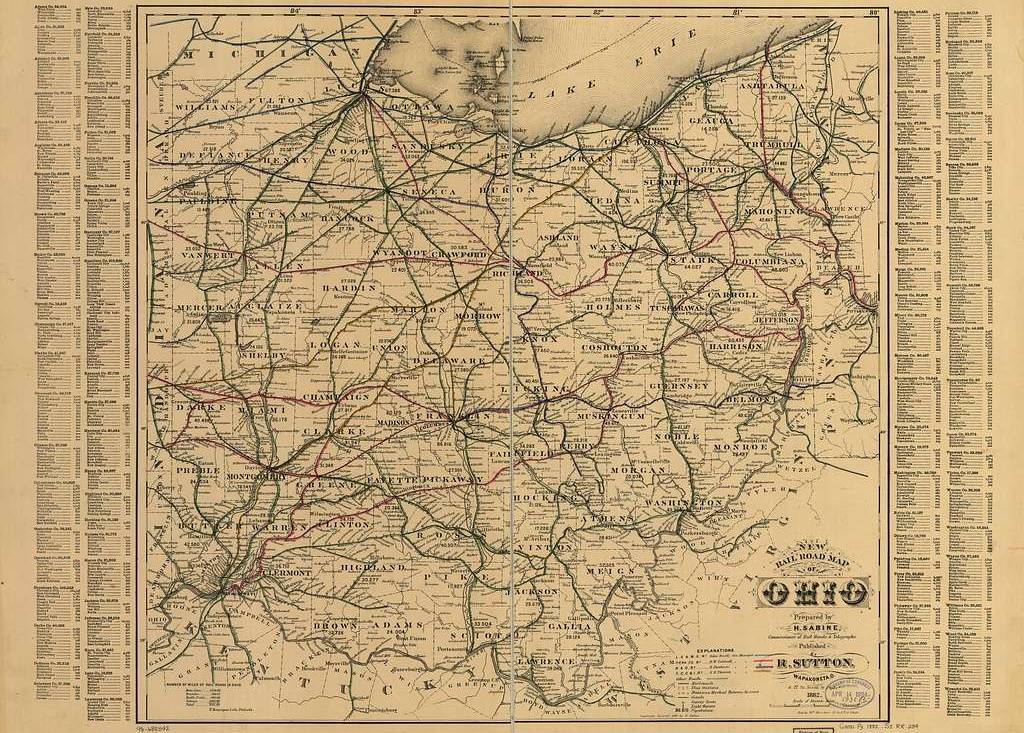
Any quick look at a map will show you that there isn’t much to do in or around Vinton County. And to be fair, there isn’t much in the nearby counties, either.
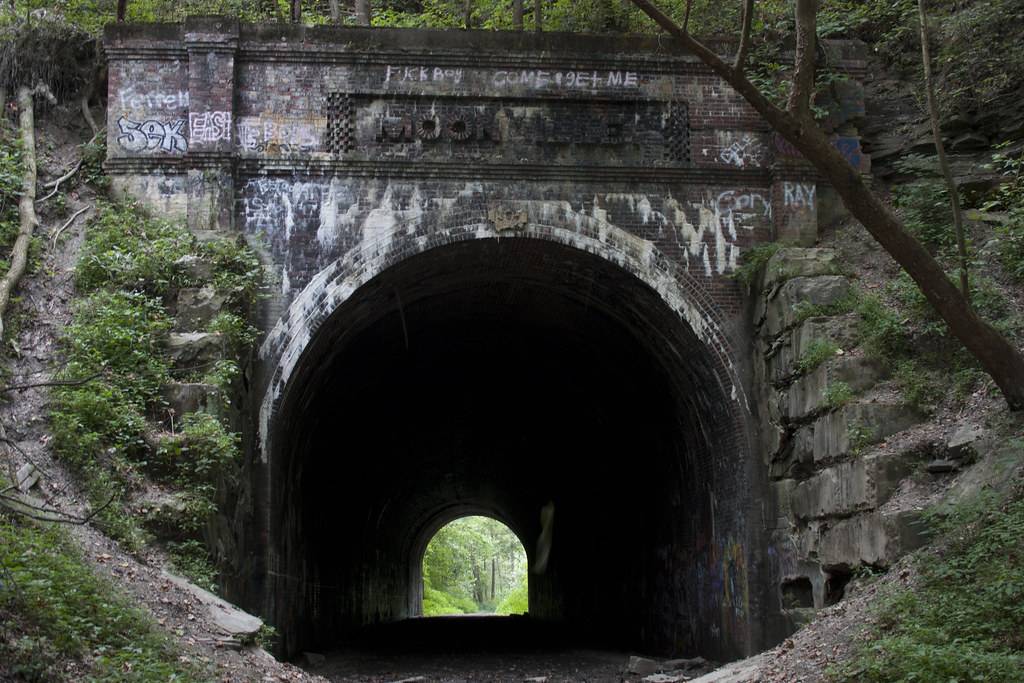
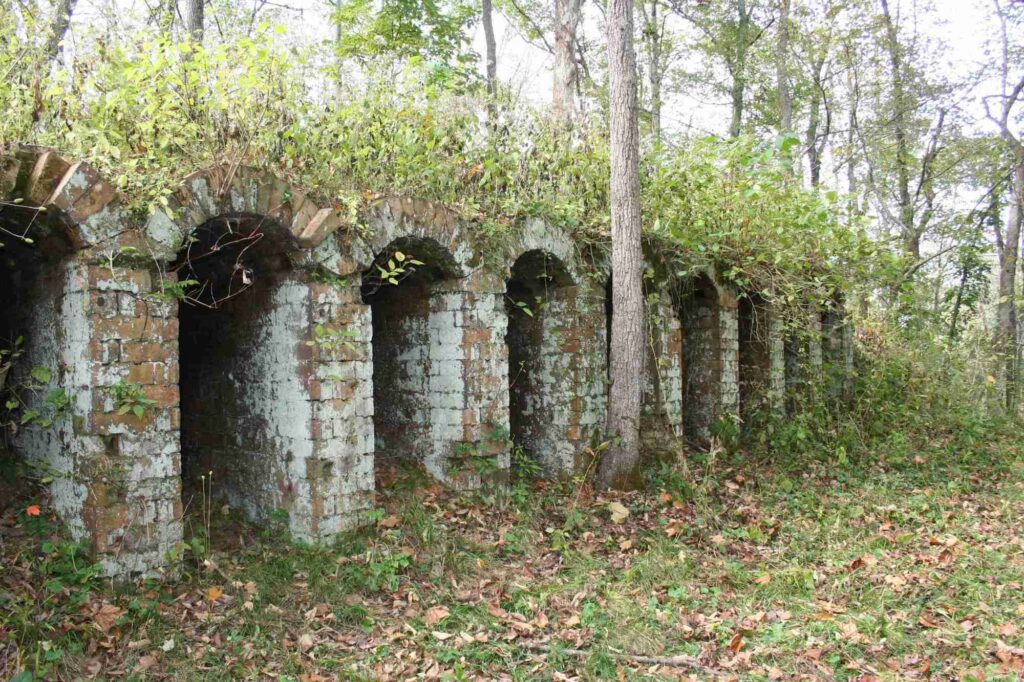
Yet, Vinton County is remembered by history. I’ve already talked about the historic Moonville Tunnel (and the ghosts they say are frequently spotted there). The county was also home to several furnaces, producing iron from the nearby mines. The timing was a bit perfect, as around the time the furnaces were to be built, new technologies and methods were being developed. Making good use of these advancements caused the Iron produced in Vinton County to be far superior to what was being produced elsewhere.
The Vinton County furnaces continued to implement the advancements, which may have also contributed to its downfall. When the massive surge of need for the best Iron started to wane, the country then started to rely on blast furnaces; however, there was just one problem. The materials going into these furnaces were so rich in Sulfur that … let’s just say there could have easily been some pretty serious, explosive problems.
The Ghost Stories of Vinton County
Moonville might have one of the more famous ghost stories in Ohio, but it is far from the only one in Vinton County.
There are legends of a ghostly Watchman, pacing the grounds of the Hope Furnace. Some may say he’s the ghost of a young man struck by lightning while making his rounds. In Moonville, there are several ghost stories as well.
Nearly every ghost story I’ve encountered in Vinton County is somehow associated with the now-defunct railways, or the mines that no longer operate.
Now, I am not here to suggest that perhaps there is a ghost of a mine owner roaming the trails around a town that no longer exists, looking for his daughter who disappeared during a rainstorm. No. What I want to look for instead is whatever bit of truth these stories can still tell.
The Real Stories
Vinton County, Ohio was once home to a fairly large number of mines, and the various furnaces and mills that dealt with the products. The Industrial Revolution has begun and the need for things like Iron and other metals are high.
So, Mr. Owner buys some land and somehow decides the best place to start digging. Sure, there’s another Mr. Owner right over that hill, and a few more Mr. Owners just across that creek, but who cares. There’s more than enough stuff down there for everyone.
Maybe Mr. Owner hires Mr. Manager, or maybe he prefers to run the mine himself. Whatever. He’s still going to need to hire a bunch of people to extract the stuff, deal with it, and send it off to be processed.
Problem is – there is no housing anywhere to be found. No big deal. You build a few “houses” where your workers can live. Problem solved. Kind of.
Your workers are going to die from starvation without food, so you probably build some kind of meeting and dining hall, perhaps a general store so they can cook their own food. And a large meeting hall is great, because they can use that for entertainment, too.
Most of these are treated more like a side-thought than anything that required actual planning. See, you want your workers to be … well, working. You require them to work twelve, maybe fourteen-hour shifts, six days a week. Mr. Owner isn’t a heartless bastard; they can have at least one day off.
These men that were hired, Mr. Owner pays them well, but not too well. Many are only making $100 to $200 per year, but they’re paying rent to Mr. Owner, buying his supplies at the store, pretty much everything they have access to is owned by Mr. Owner so it’s hard to really fathom how much money these peope are getting paid.
Records indicate that the vast majority of workers are somewhere between 15 and 30. Life expectancy for these workers is incredibly low – partly on account of there being no Mr. Local Doctor, and let’s not forget how dangerous all this work truly is.
I would have to say that life, for Mr. Worker, may not be as great as he would have hoped. They’re from one of the generations where men work hard, provide for families, don’t complain about things like back pain or wanting a day off to attend their sister’s wedding – they were told it’s there lot in life to work, to provide, and if that is what they’re doing, they’re on the right track.
When they don’t feel like they are providing for their families (which, let’s face it, is probably more their mother than their wife, they’re told that if they just work harder, put in more hours, they’ll be able to provide more.
So, Mr. Worker puts up with conditions we would describe as somewhere between “inhumane” and “don’t we have laws that prevent this kind of crap?”
Maybe what Mr. Worker doesn’t expect, at least not at first, is how much control over their lives Mr. Owner has. They’re not slaves, exactly – they get paid and were hired not bought. Yet, somehow Mr. Owner controls just about everything they do. He’ll tell you that you’re expected to hang out at the Meeting Hall every night, and on whatever day you have off – partly because of that above-mentioned financial thing, but he also knows that left to your own devices, you might get in trouble – the more workers he has getting in trouble the less his mine makes – so, isn’t this a win for everyone?
There was one thing, however, that Mr. Owner didn’t expect that would ultimately cause all these Company Mining Towns to fail – The industrial revolution didn’t exactly last as long as everyone was thinking.
When everyone needed good quality Iron to build the trains and the tracks they ran on (not to mention the bridges and all that, too… When everone needed good quality Iron to build the new skyscrapers and the new aglets (the little thing on the end of your shoe laces that prevent them from fraying) … this sure felt like the New Future.
But, what’s going to happen once everything has been built? Ok, not everything. But … when the need for Good Quality Iron wasn’t nearly as high as it used to be because they’re not building as much as fast as they were?
Some of the Mr. Owners closed their mines completely as it just wasn’t financially a good idea anymore. Others tried to adapt.
Since everything we do produces Good Quality Iron, they thought, we’ll just start to make Good Quality Other Things instead.
Problem was – what made good iron made lousy other things. So before long all these corporate towns were abandoned.
There were, however, a few that survived. These were towns that had other things going on, relied only partly on the mining industry, catering to other professions just as much – like, say, farming. So, today, there are still a few little towns left over in Vinton County, if you can call them towns. Many just look like a small group of houses that somehow landed in the same geographic region, but if they want to call themselves a town or village or semi-incorporated group fo neighbors, who are we to judge.
These ghost stories are important to remember, not because of some supernatural element that may or may not exist – but because they reflect the times. They tell fo workers pushed to their limits in unsafe conditions, they tell of corporate greed and man’s desire to live The American Dream, no matter the cost.
They force us to look at this era of history, not with modern eyes and their modern perspectives, but to look and try to understand what it was really like way back when.