Sometimes, while doing research for one article, I’ll run across something that isn’t exactly related to what I was looking into. History doesn’t happen in isolation, after all. I’ll write down some notes and come back to it later. On rare occasions, this leads me down one interesting rabbit hole after another, to the point where I have tottally forgotten the original reason I wrote the note in the first place. Most recently that happened while researching the history of Vinton County and ran across the name: Mauds Collins.
Maude’s Early Life
Born Maude Charles, she lived with her family in rural Kentucky. Her father was Roland Thomas Charles, her mother Francis McCoy, or Frannie, or simply Annie. While you may not know her, you may have heard about her family. Her father’s name was Ramdpolph McCoy.
On August 30, 1863, Devil Anse Hatfield (Yes, that was his name) got into a little argument with Randolph over … something … and before long the Hatfield-McCoy Feud spiralled out of control, getting bigger and bigger until the history books just had to record it. I’m sure you’ve heard about it.
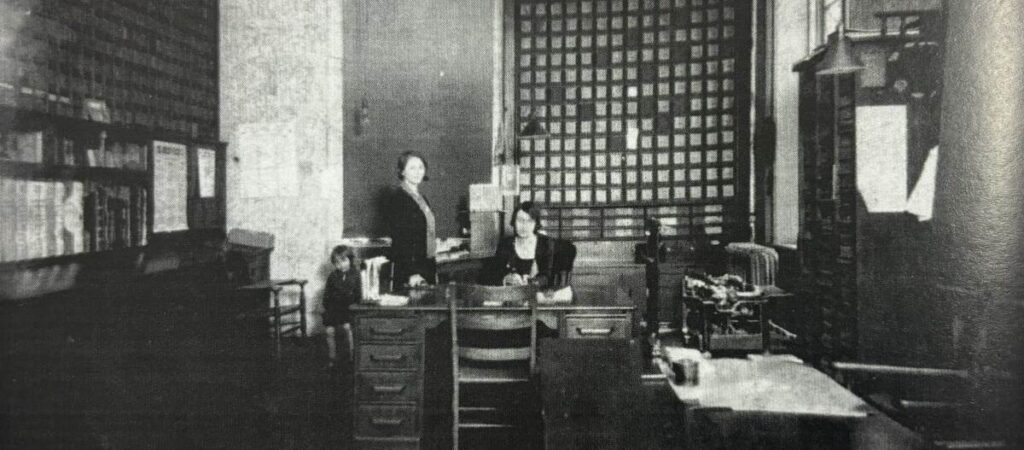
As a young lady, she married Arthur “Fletcher” Collins, former Navy Serviceman and soon to be Sheriff of Vinton County, Ohio. As the wife of a sheriff, she would have lived in the Sheriff’s House, physically located next to the Vinton County Sheriff’s Office and Jail. Her duties as the Sheriff’s Wife would be to act as a Matron for the jail.
On October 8, 1925, Sheriff Fletcher Collins was shot to death by George Steele, as the Sheriff attempted to arrest the man. Within hours, he would be caught and face punishment, not just for the original charges, but for the murder of Collins as well. When he was taken into custody, officials feared that there would be violence, as Sheriff Fletcher and his wife Maude were so loved by the community. He was transferred to Columbus without incident.
According to laws of the time, the county coroner should have been the one to step into the Sheriff position, however the man politely declined. The only other way to fill the Sheriff’s position would be to hold an election, but what to do until then. One of the customs at the time suggested that the widow fo any politically elected official could step in, usually just as a symbolic gesture, until the next election.
Maud’s reasons for accepting the Shefiff’s title could easily have been more logistical than anything else. This was the 1920s in Rural America, and after her husband’s death, should anyone else have accepted the Sheriff’s job, she’d have had to pack up everything for herself, as well as their five children, and hope they had found something soon. This, if nothing else, gave her a bit more time.
Shefiff Maud
In 1925, it was all but unheard of to have a female Sheriff, but she seemed determined to make the best of it. She already had the respect and admiration of many locals, considering how well loved her husband was during his time as Sheriff. So, maybe this helped things along a bit.
Maude refused to sit idly by and act more like a placeholder than an actual Sheriff – she took her responsibilities seriously and performed her duties as needed. It didn’t seem to matter if she were transporting violent criminals to a detention center or whatever crimes were being reported.
Her hard work and dedication seemed to impress everyone and after the next election, she officially became the first woman to be elected Sheriff in Ohio.
Just on a side note here … in 1976, a woman named Kathy Crumbley was elected as Sheriff of Belmont County, Ohio and for a short time tried to claim she had been the first female Sheriff in Ohio. Somehow, it seems the world had temporarily forgotten about Maud, until a small group of historians put the record straight. It also might be worth noting that this was a mere four years after Maude Collins herself had passed away.
Sheriff Maude Solved A Case
On November 11, 1926, a fourteen-year-old boy named Manville Perry made a gruesome discovery. His mother had sent him to their neighbor’s house (a lovely couple named William and Sarah Stout) for some reason. When there was no answer at the front door, he walked to the side of the house where he found the living room door left open. He stuck his head inside and saw something no teenage boy should have seen.
Sarah’s body was laying on the in the living room, right in front of the stove, burnt beyond recognition. One of her arms was extended in front of her, but it showed no signs of burn marks. (So, whatever she had been doing – it wasn’t trying to extinguish any flames.)
The prosecuting attorney (accompanied by two doctors) processed the scene of the crime. They were able to determine that Sarah had been beaten and strangled, then dragged to the heating stove before being set on fire, most likely to destroy evidence.
Two days before the murder, Sarah had been seen in McArthur signing a warrant against her stepson Arthur, saying that he had walked out on his wife and kids and was currently living with his girlfriend, Inez Palmer, in another house on his father’s land. The reason she made this complaint is up for debate. Most sources say that Sarah was a “decent, God-fearing woman” and enjoyed a certain status in life – a privilege which was threatened by her husband’s adult children acting in such an openly sinful manner.
Arthur was not pleased to hear that the woman who had recently married his father did such a thing, and reportedly he threatened to kill her. This made him the first suspect in Sarah Stout’s murder.
When interviewed by Maude Collins, Arthur denied having anything to do with his Stepmother’s death. Arthur was taken into custody anyway for living with a woman who was not the one he was currently and legally married to. He was, by popular opinion, the prime suspect in Sarah’s murder.
As part of her investigation, Maude noted some footprints leading from a wagon Arthur had hitched to a fencepost to the door where Sarah had been killed. Some bloodhounds brought in by Sheriff Maude traced the footprints back to Arthur.
When questioned, Arthur initially told the Sheriff that he had not seen his stepmother at all that day, but when faced with this new evidence, he changed his story. Now he said that he did approach the house but did not go inside because he believed nobody was home.
It wouldn’t be until January of the following year before Arthur would be arrested – for the murder of Sarah Stout and for “improper relations” with Inez Palmer.
Immediately following Arthur’s arrest, Inez Palmer moved from Arthur’s house into William’s and began working as his housekeeper. This, apparently didn’t seem too odd at the time, although it’s hard to know what people were actually thinking.
Then, in March, William disappeared.
According to Inez Palmer, the two had a disagreement about something and he got mad and left, saying he would never be back because he was headed somewhere “out west” to start a new life.
Sheriffs discovered a set of footprints leading from the house to a nearby creek where a wood pail was discovered. Inside, a will – supposedly signed by William, giving everything to Arthur, cutting all his other kids completely off.
To Sheriff Maud, there was a lot about this that seemed suspect. She did not buy the story Inez was telling, noting that if William had moved “out west” then why would he leave all his earthly possessions behind? Secondly, he was starting to believe that Arthur had killed Sarah, and had even commented that if it were true, Arthur should suffer the worst of consequences. Does it make sense that he would then go and leave everything to him and not his other children?
But, it was the footprints that seemed the most off of all.
William’s body would soon be discovered at the bottom of the property’s well.
What Sheriff Maude noticed was that the footprints from the house to where the will was discovered, matched Williams shoes, exactly – however, the impressions left in the dirt were not nearly as deep as the ones the other men were leaving behind. Arthur was a large (okay, normal sized) man nearly the same size as sa the deputies investigating his disappearance, so what could account for this discrepancy? Was it possible that someone else, someone who didn’t weigh as much as the average male … could they have been wearing the shoes when the tracks were made?
Sheriff took the will to ne town bank and compared the handwriting and the signature on the will to documents he had written and signed at the bank. Her suspicions were confirmed – whoever wrote the will was not William. The document had been forged. Arthur was still in prison awaiting trial for Sarah’s murder … and if he couldn’t have done it – who else was there?
His girlfriend … Inez Palmer, perhaps?
Sheriff Maud, as well as a Deputy Sheriff named Cox, interviewed Inez and after presented with all the evidence they had against her, she … confessed.
Inez Palmer confessed to beating and strangling Sarah Stout before, at Arthur’s direction, moved her into the living room and set her on fire. For some reason, perhaps because the floor was made of non-flammable materials, the rest of the house did not burn.
She then confessed to killing William and making it look like he ran off after an argument. She (and Arthur) believed that if they could put the blame for Sarah’s death onto William, Arther would be freed and the two of them could live together and continue their relationship.
I would like to think that eventually, even without Maud’s observations, the crime would have been solved correctly anyway. However, there was a fair bit of misinformation being reported on that easily could ahve confused the matter.
In mystery fiction there’s always that last clue that sets the detective onto the correct parth – and someimes we wonder if it’s like that in real life. But, here’s a clear case where that exact thing happened.
After Sheriff
It really cannot be understated the effect that Maude Collins had, not just in Vinton County but also the nation in general. This was, after all, only a few years after woman were granted the right to vote, even if they were not allowed to open their own bank accounts (which wasn’t allowed for a few more decades) without their father’s or husband’s permission (and, usually, financial backing).
After she took over the position following her husband’s death in the line of duty, the newspapers seemed to cover this as if it were some kind of novelty. Headlines with words like “Widow Sheriff” or articles that referred to her as “Mrs. Fletcher Collins” were common, as if it was impossible for anybody to think she would have any success. Yet, that’s exactly what happened – she had a lot of success. Her solving of the double murders committed by Inez Palmer and Arthur Stout caught national attention, with national papers suggesting that only a woman could have solved it because no man would likely have noticed that some footprints weren’t as deep as others.
This was not the only murder she is credited with solving, and her dogged determination against prohibition era moonshiners also became particularly noteworthy – but considering her family ties to one of the most notorious (not to mention deadly) family feuds in American history might have something to say about that, too.
After her time as Sheriff, she would continue to do good work as a clerk of the courts, then taking a position as Matron for the Columbus State School.
Sadly, by the time she passed away at age 87 in 1972, she was already nearly being forgotten.
Today, on the side of the courthouse in Macarthur, you can visit a mural dedicated to (and depicting her) comissioned by the Ohio Arts Counsel. You can also visit an official historical marker locatred just south of the intersection of Market and Main Streets.