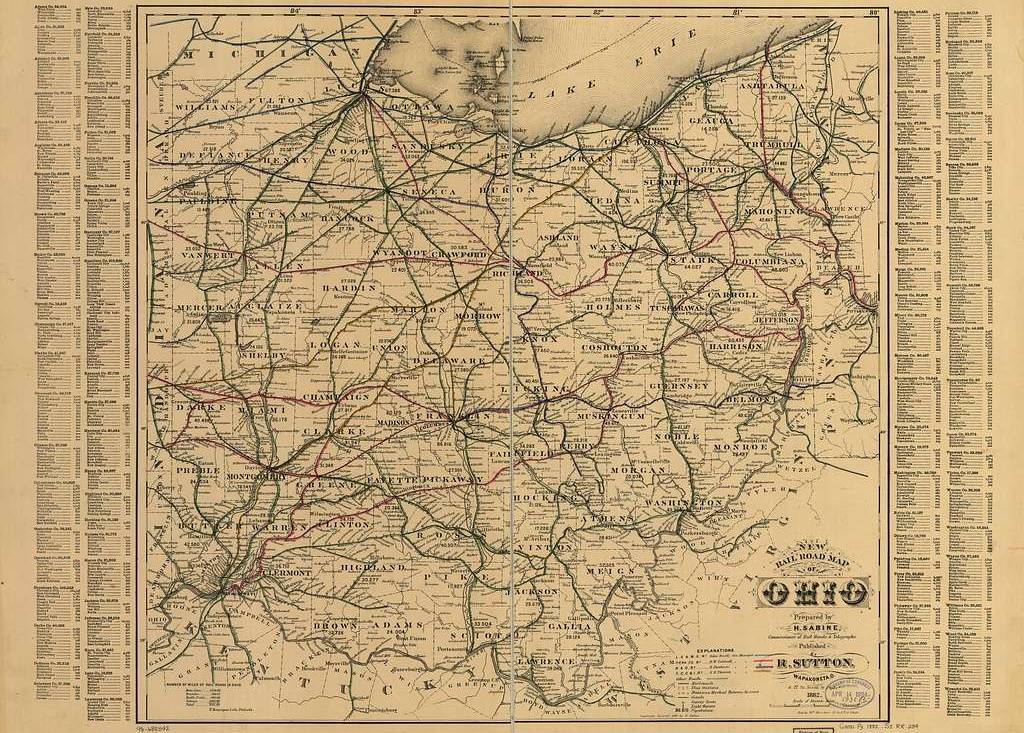
The date was February 8, 1844. The time was 1:30 in the afternoon. Location: the grounds of The Columbus Penitentiary. The event: Thousands of people filled the hill to witness the execution of two criminals because what else was there to do on a chilly afternoon in the middle of the nineteenth century.
The first condemned was William Graham Young (or William Clark) who was already incarcerated at the Penitentiary when he killed a guard, for which he was sentenced to death.
The other condemned was named Hester (or Ester or Helen) Foster. She would be the first female executed in Ohio for her crimes. Who was this woman? What did she do? Why did she do it? Well … we’re not entirely certain. It’s complicated. Just about the only thing we know for sure is that she was executed that day.
An Unsolved Mystery (Kind of)
As an (armchair) historian, it seems kind of odd to me that we know so little about the first woman to be executed in the state. I suppose, in the state’s defense, that was a long time ago, times and attitudes change; records are misplaced or are otherwise lost to time – so in a way that’s to be expected. Yet it still seems a bit … off.
At least we know her name… Hester Foster. (Sometimes Helen or Ester.)
The man she was executed with, William Graham (sometimes William Clark) … we know a lot about him. We know his crimes, we know how he murdered a guard and how he tried to claim “temporary insanity” to avoid his execution (spoiler alert – it didn’t work.)
How come we know so much about him, but not her?
Not to try and play the “sexism card’ here, but it could have something to do with how she was a woman. The roles women played (and how they were viewed) in society has changed a lot since then (Did you know they can actually vote now? And open their own bank accounts without having to have a father or husband sign on the dotted line?)
We know that the first female executed in Kentucky was an enslaved woman named Phoebe in 1808. Her case was documented well because it caused a debate over how enslaved people could be charged with crimes.
If we go in a different direction, we know the first woman executed in Indiana was Lisa Montgomery who was convicted of killing a pregnant woman and ripping the unborn baby out of the mother’s womb. You might actually remember hearing about this because it was a bit more recent – the murder was from 2007, the execution was carried out in 2021. (And it was the first Federal execution since 1963.)
Following The Clues
Some people say the Columbus Cultural Arts Center is haunted. Because of course it is. It’s located in an old building. Its location is just a stone’s throw away from what was once the gallows’ hill of the Colombus Penitentiary. And, really, what cultural arts center isn’t haunted? Am I Right?
Students and faculty (and, I suppose visitors, too) might complain about certain locations feeling much colder than it was two feet away. They might whisper about moving shadows or a ghostly female in some kind of Victorian era outfit floating down the hall or up the staircase.
All in all, pretty much what you would expect.
But then a local paranormal podcast called The Q-Files found out about this, and they had to investigate. During their pre-show investigation (basically doing background research) they managed to locate an old Murder Pamphlet that detailed (at least to some degree) the life and times of Hester Foster.
There’s a small problem with Murder Pamphlets, though – one that’s impossible to ignore.
Historians (and Genealogists) refuse to accept them as reliable sources.
These pamphlets were mass produced and sold at executions and by their very nature were designed to make money and give people something to gossip about. Often, these were written by the publisher (or printer) without any direct knowledge of the subjects or people involved. Information was not fact checked, and anyone in the publishing business will tell you that the more sensational something is – the better it sells.
In other words, nobody had the incentive to tell the truth and may have had every reason to fudge things if it meant selling more copies. Nor was there anyone to complain to if something was wrong.
That being said – pamphlets like this were meant to be disposable, usually printed on (and with) subpar materials, so the fact that one survived at all makes it an interesting historical document.
Hester Foster’s Story (According to the Murder Pamphlet)
(Please bear in mind this information may or may not be accurate.)
Hester was born on Christmas Day in Philadelphia, the union of an Irish Immigrant and an indigenous woman. When Hester was three, her parents split and she was sent to live with a relative in Cincinnati. Soon, these relatives were unable (or unwilling) to care for her and she bounced around between places where she was frequently abused.
As a teenager, she was reunited with her biological mother who lived in Louisville, Kentucky. Before long, she got married and had gotten pregnant and gave birth to twins. At this time, her mother gave her two enslaved people and some money to start a new life. After an argument, the twins’ father walked out of their lives, leaving Hester alone with the twins. She freed her slaves before escaping back to Cincinnati.
That year, she received a letter from her mother that informed her that one of the slaves that she had freed had killed her (the slave’s) husband and their two children. This news caused her to break down, turning her to every illegal vice and wickedness she could find.
One day, Hester and a couple of friends met for an afternoon of drinking when Hester and her friend followed a woman into some woods with nefarious intentions. Hester claimed that she did not attack the woman, just stood by watching while her friend did all the dirty work, but she was found guilty and sent to prison.
While in prison, Hester and another inmate named Louisa White developed some kind of rivalry. Half of the inmates, it seems, were on Louisa’s side, the other half linked with Hester. The division got so bad that the two gangs were separated into different wings.
On March 13, 1843, Louisa entered Hester’s wing, armed with a shovel, trying to end this feud by taking out her rival. But that’s not what happened. Instead, during the fight Hester managed to get the upper hand, and the shovel. She shouted something about if Louisa wanted a murder, a murder was what she was going to get – and then proceeded to smash the shovel repeatedly into Louisa’s head until she was dead.
For this – Hester Foster was sentenced to be executed.
Is This Story True?
All I can say is … some of it is true. The rest … we’re not entirely sure.
One fact that we can rely on was that on February 8, 1844, a white man named William Clark was executed at the Columbus Penitentiary, alongside a Colored Woman named Hester Foster. We have records that document this – and there are numerous newspaper accounts from people who were there – and for the most part, they all pretty much agree on what happened.
The two executions were vastly different.
Clarke seemed to accept his final punishment, bowing or kneeling during somber moments, and displaying a clear sense of remorse. Foster, on the other hand, proved to be quite the spectacle. Her actions were the polar opposite.
The crowd outside didn’t help much, either. Takes of public drunkenness and unruly behavior quickly drew attention of nearby military bases who sent troops to help keep the crowd in line.
Several of the witness accounts from the papers drew attention to the barbarity of the situation, asking how ending someone’s life became an afternoon of entertainment. One writer noted the number of women in attendance and pondered if there was no decency anymore.
Some historians looking at these records have pointed to one word used reputedly that they believe call the rest of the story into question: that word – colored. Some accounts specifically refer to her as “black” while fewer use the term African.
In her confession, Hester claims her father was Irish while her mother was a native American. It is possible that people referred to her as “colored” but maybe more likely another word would have been used. That, on its own, shouldn’t be cause for concern.
However, according to her confession, she lived with her mother in the state of Kentucky, and they both owned slaves – this does seem unlikely. I was also unable to find any record of this via public databases and newspaper accounts. I’m not comfortable ruling this out as a possibility – but it may be worth further scrutiny.
The Mystery Left Unsolved
Someone once said that the best lies are the ones wrapped in the truth – and that may be the case here. We do know that a “colored” woman named Hester Foster was executed that fateful day and we also know that she was the first woman to be executed on Ohio soil. We know she was executed after she killed a fellow inmate,
What we don’t know, at lleast with any degree of certainty, was who she was.
I found no records that Louisa White ever existed in Ohio, let alone murdered by Hester Foster. (But, that information could be lost to time.)
Historical records state that after Foster’s execution, Ohio has only put three other women to death – although during a sizable period of the state history, nobody was executed at all.
To some, it may be a morbid curiosity – the first woman executed. To others, it’s a hole in our history that may, someday, be filled.