In the afternoon on Saturday, October 25, 1975, all eyes turned to Ohio. Well, not the whole state, exactly. Not even a city or a town or even a village. It was just … a parking lot. Well, at least it was a big one. Huge. Actually, the world barely saw more than 133 feet of it, so … I guess the world stopped for a minute to focus on a small portion of a parking lot. Allow me to explain.
Let’s Back Up For A Minute
In 1938, a boy named Robert Craig Knievel was born in Butte, Montana. As a boy, he attended an auto daredevil show and was inspired by the show’s star, Joie Chitwood. Since then, Robert knew he wanted to thrill audiences and perform cunning stunts.
A few years later, he’d drop of out high school to work in the mines to help support his family, although that career was fairly short lived. Then he tried working with a few rodeos and trying his hand at amateur ski jumping, neither of which lasted very long, either. He joined the army and served a term before getting married, then trying to create a semi-professional hockey team. This led to even more short-term careers, not to mention little of what we like to call “success”.
Which … when we look back past everything … could explain a lot. But let’s not get too far ahead of ourselves.
Eventually Robert opened a Honda motorcycle dealership but didn’t have much success selling Japanese bikes to American buyers. If only he could come up with a gimmick… That didn’t happen and his shop was forced to close. From there, he got a job at someone else’s motorcycle shop and it was there that he learned about the world of motorcross and get his inspiration for jumping over things on a motorcycle.
In 1965, in his then hometown of Moses Lake, Washington, he branded himself as Evel Knievel. He liked the “evil” sound that gave him some air of danger, but didn’t want to come across as something bad. So, he changed the spelling to “Evel” which kept that edge, but was also a play on his last name, Knievel.
Evel Knievel performed his first official stunt, a 40-foot jump over a small cage with two mountain lions and a box containing some rattle snakes. History would record his first jump as a success, however his back tire did clip the box of snakes, causing it to open. He still landed his Honda 305cc Scrambler as planned, although he sprained his ankle in the process.
Over the next decade, Evel would continue to make jumps, trying whenever possible to make the jump bigger, or at least more of a spectacle than the last one. After jumping over lions and snakes, his second jump was over two parked pick-up trucks, which he executed somewhat perfectly. On his third event, in February, 1966, while trying to jump over a moving motorcycle, he missed the ramp and the jump failed. He also broke his groin. (Ouch.)
If there was one thing that Evel really wanted, it was to be on television – and the only way he saw this happen would be on ABC’s Wide World of Sports, which he contacted several times but was initially rejected. Eventually, though, they would change their minds.
On March 25, 1967, Evel successfully jumped his Triumph Bonneville T120 over 15 cars, landing successfully – and without injury. This time, the whole world (or, at least anyone who could tune into Wide World of Sports) could watch.
Now that he considered himself a successful stunt performer, he began trying to be a force for good – usually by greeting the gathering audiences and talking about how kids should stay off drugs. Somehow, that message would become a part of his brand. He would also speak out against the Hells Angels – particularly due to their involvement in the illegal drug trade, which the group clearly did not like. Also, in 1977, he filmed a movie in which he played a fictional version of himself, using stunt performance moves to foil and take down a drug kingpin trying to smuggle substances over the US border.
Even though most of his jumps were mostly successful, he did manage to frequently hurt himself. While jumping 16 cars in Tacoma, he got a concussion. In his widely publicized jump over the Cesear’s Palace fountains in Las Vegas, he crashed upon landing and spent nearly a month in hospital with multiple broken bones and a smashed pelvis. His next jump after that resulted in a broken leg and fractured foot.
If there was one jump that Evel wanted to make – it was the Grand Canyon – yet, for some reason, the government really didn’t want him to. I suppose it would look bad if one of the nation’s most popular stunt performers died while attempting to jump over such a landmark – so maybe they had a point.
Evel still wanted to jump something like that – so with the Grand Canyon out, he turned his eyes to the Snake River Canyon in Twin Falls, Idaho. On September 8, 1974, he would attempt this jump, but … almost from the start things were getting off badly. First off, Wide World of Sports didn’t want anything to do with him anymore after the crash landing at Ceasar’s Palace … and by now the insurance companies no longer wished to insure him, which was a requirement at most venues.
Evel wound up hiring a boxing promoter who was willing to film the event, which would then be broadcast to select movie theaters throughout the US. Ultimately, everyone who invested in this lost money. It didn’t help that the bike’s engine overheated before he even hit the ramp, or that the parachutes malfunctioned and began to deploy before he was even off the ramp. He did manage to make it across the canyon, however winds carried him off course before they ultimately took him to the bottom of the canyon, at the water’s edge (the same side he took off from). Evel somehow only managed to suffer from a broken nose and a few cuts and scrapes.
So, yes – that jump was a bit of a disaster.
Six months later, he would attempt a jump at Wembley Stadium in London. Here, with support from Wide World of Sports, he attempted to jump 13 single-decker London Busses, but again the jump went wrong and he crash landed. He got another concussion, a broken hand, and a fractured pelvis.
While promoters were all insisting that he be removed via stretcher, he refused. But, first, he wanted to address the crowd. “Ladies and gentlemen of this wonderful country, I’ve got to tell you that you are the last people in the world who will ever see me jump. Because I will never, ever, ever jump again. I’m through.”
Evel … Um … Retires?
After the Wembley Stadium jump, Evel sounded like he was done. He would frequently comment about how a good jumper knows when it’s time to throw in the towel and for him that time had come.
A few biographers have speculated that because his final jump was deemed a failure, he would have wanted to go out on a high note. He really wanted his last jump to be a success.
At the time, King’s Island was a relatively new amusement park, and their publicity department had been working overtime trying to come up with creative ways of getting the word out there. In 1972, one of television’s hottest families, The Patridge Family, paid them a visit although that episode wouldn’t air until January, 1973. Later that year, Television’s other hottest family, The Brady Bunch, would likewise film an episode there. Both episodes tried to be legitimate stories, yet both felt more like a half-hour commercial than anything else. (Still, it was great publicity for the park.)
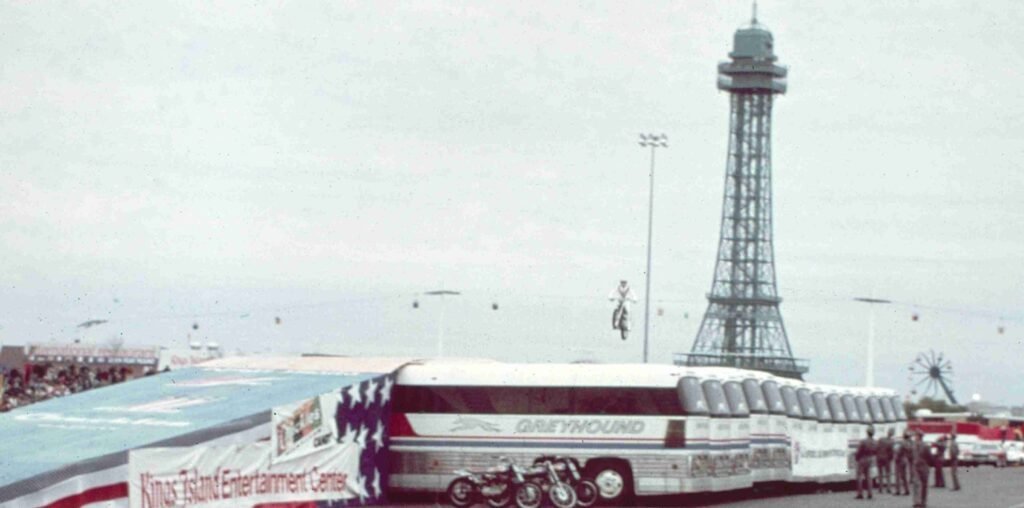
Now we come upon October 25, 1975 – Evel Knievel has decided that he has one last jump in him – this one is going to take place in the parking lot of King’s Island. He will attempt to jump 14 Greyhound busses, spanning 133 feet, riding on a Harley-Davidson XR-750. And Wide World of Sports was going to be there and film everything.
His previous two jumps (Snake River and Wembley Stadium) were less than successful – and he stated to media that he wanted to end his career on a high note. He wanted everything to go right … while the viewing public knew very well that everything could go wrong.
With much fanfare (and a speech to the crowd urging kids to not use drugs) he got himself prepped and ready and performed the jump.
And it ended … in success.
He had done it.
Evel said in interviews that this was his final jump.
By now, it would probably come as no surprise that the following year, he made two more jumps. In Worcester, Massachusetts he successfully jumped over 4, then 7, then 10 vans. Then later, at the Kingdome in Seattle, Washington he would successfully jump 7 Greyhound busses.
These jumps were a bit different, though. Up to now, with every jump he tried to make it bigger, better, and longer – but here he was going the other way.
Then came his final (no, really) jump. January 31, 1977. Chicago, Illinois.
I am not making this up. He was going to jump … sharks. Thirteen of them. However, during a practice run, he crashed – fractured his collar bone, broke his right arm, and had more scrapes and bruises than he could count.
After this, he would try to set up two additional jumps, neither of which would ever take place.
Meanwhile … and I want to end this on an interesting note … there had been a popular television show called Happy Days that was declining in ratings. It still had a loyal following, but those numbers were getting smaller and smaller. The show had wanted to do something to attract viewership – they wanted to something cool – something that had never been seen on television before.
A few months earlier, Evel Kinevel had tried to jump his motorcycle over a cage with live sharks – and … for some reason … that’s what they decided on. They were going to have the show’s most popular (and coolest) character, Fonzie, jump over a live shark. The only difference was going to be that he’d do it on water skis, not a motorcycle.
So, in 1977, Happy Days jumped the shark. Only, it didn’t have the intended effect. Rather than seeing this as something cool and hip – it was mostly viewed as some kind of lame, attention seeking stunt.
After this, the phrase “Jump the Shark” entered the public vocabulary. It refers to situations where something has evolved passed its original intentions and introduced something new in hopes of revitalizing everything but winds up having the opposite effect. The phrase is directly attributed to Happy Days, which wouldn’t have been possible had Evel Knievel not wanted to try it first.
In the greater scheme of things – Evel’s last spectacular jump was held here in Ohio, in the parking lot of King’s Island. It was here that he broke his final record, entering the Guiness Book of World Records for the final time – unless they created a category for an individual with the most broken bones, which he would of course win.