Sometimes, the most interesting news stories don’t reach the public attention until after everything has been said and done.
At first glance, this seemed like just another case where law enforcement executes a search warrant, leaves behind quite a bit of damage, then claim they were not responsible as they were just doing their job. By the time the story concluded, it had become an epic battle over free speech that, at least for a moment, captured the public’s attention unlike anything else.
The Search
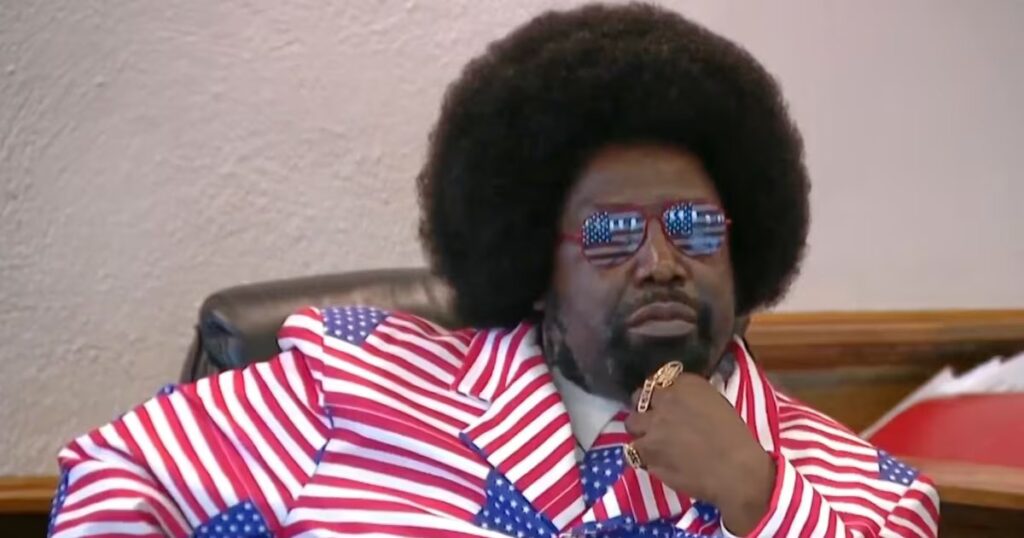
Back in 2022, a group of police detectives arrived at the home of a guy named Joseph Edgar Foreman, a musician and rapper that goes by the name Afroman. Apparently, law enforcement had gotten an anonymous tip that the man was involved in drug trafficking and that he also had some females chained up in his basement for nefarious reasons.
As police sometimes do in situations like this, they obtained a search warrant which they chose to execute one day in August.
Police entered after smashing through the front door, weapons drawn, and then proceeded to search for evidence, going through the man’s personal belongings. They confiscated quite a few items plus a rather large stash of cash the man kept at home.
What police did not find was any evidence of drugs, drug trafficking … they discovered no female captives in the basement, nor were there any signs that there ever had been.
By the time everything was over and done with, Foreman was cleared of any suspected crimes, and most of his personal property that was seized was returned to him (although he did claim that a small portion of the money had gone missing).
That could have been the end of the story, except that during the search, police left quite a bit of damage to Foreman’s property and like any homeowner, that was upsetting. He tried to get some kind of reimbursement from either the police department or the city, but the law was not on his side for this one. The warrant was executed in good faith, even though the police found nothing. Therefore, as a homeowner, he was responsible for fixing whatever got broken or destroyed.
Two Kinds of Videos
Neither Foreman nor his wife were at home when the police knocked down their door. However, there were security cameras pointed at the security gate, the front door, and several stretegic points around the house that recorded … everything. At least, until the cameras were … somehow … deactivated.
On television and in the movies, police searches are usually depicted as some kind of controlled chaos. Things are done by the book, otherwise the slightest infraction would result in a major plot twist. But, in the real world, police searches can get pretty weird. Even in normal situations, unusual things have been known to happen.
One of the more noteworthy moments of this weirdness occurred when an officer, while searching the kitchen, stopped what he was doing to investigate a Lemon Pound Cake. Why did he do this? It’s hard to say for certain. All we know for sure is what we see on the video.
Foreman did what any musician could have done in a situation like this. He sat down and wrote a song. He called it “Lemon Pound Cake” and the song goes something like this:
The Adams County Sheriff kicked down my door / Then I heard the glass break / They found no kidnapping victims / Just some Lemon Pound Cake
Then he wrote another song. And another after that. Before long, he had an entire album’s worth of songs. The track listing for the album, which he called “Lemon Pound Cake” includes titles like “The Police Raid” and “Will You Help Me Repair My Door” and “Some Days When Your Life Is Hard”.
Foreman … okay, I should now call him Afroman at this point … released a few music videos for the songs on that album. Those videos featured footage that his wife had taken on her cell phone camera, as well as videos from the various security cameras he had installed at his place.
While this exact scenario has not made its way through the courts, several similar cases have and by law, Afroman had every right to film the police during their search of his house, that footage is legally his and he is free to do whatever he wants with it.
The problem is that the police didn’t like the video, they didn’t appreciate the words in the songs, so they asked Afroman to take down the videos and stop promoting those songs.
Afroman responded by saying that he has a First Amendment right to Free Expression.
A Legal Battle
Several of the officers who were involved in the search of Afroman’s house (and were featured in the music videos) filed a lawsuit against Afroman (and his music company) saying that it portrayed them in a negative and objectionable light.
They claimed his videos were an invasion of their privacy, including producing merchandise with their likeness without their permission or consent.
Furthermore, they claimed that the videos caused extreme and outrageous emotional distress.
And finally, Afroman and his company acted together to profit from unauthorized use of their likeness or videos.
Before any courts could get involved, this case was tired in the court of public opinion because … of course it was.
For Afroman’s supporters, this case was all about free speech.
To others, this was an attack on hard working police officers trying to protect and serve their community. They tried to paint Afroman as angry and trying to get revenge against the police after they unfortunately damaged some property while executing a search warrant.
Afroman, in return, filed his own suit against the officers, stating that their actions during the executed search warrant caused damage to his home and property, which they refused to take accountability for.
However, this countersuit was quickly thrown out by the judge.
The ACLU (American Civil Liberties Union) then became involved in support of Afroman. They equated the case against Afroman as a SLAPP Suit (a Strategic Lawsuit Against Public Participation – or, in other words, a case that has little to no legal foundations that serves more as a form of intimidation or one that tried to burden or silence the other party).
What Does Barbra Streisand Have To Do With This?
Technically … nothing. She wasn’t involved in any way, shape, or form. However, the story so far is the pefect example of “The Streisand Effect.”
In case you were unaware – many years ago (the year was 2002), the California Coastal Records Project was established to document the effects of erosion on the California coastline. Part of this meant that photos had to be taken at regular intervals all along the western edge of the landmass we somehow named California. These images were then collected and published in a database that hardly anyone even knew about because “Coastal Erosion” isn’t a hobby for most folks.
In 2003, Barbra Streisand somehow became aware that one photo (one with the imaginative title of “Image 3850”) contained a view of her Malibu Estate and demanded that it be removed as it violated her celebrity privacy. Two years later, the court battle was over and Streisand lost, the picture was allowed to remain.
By now, millions of people (I am guessing) have seen the photo of her house. It’s also worth mentioning that had Streisand not told anyone that Image 3850 was her mansion, nobody would have known it was hers in the first place.
In 2005, Mike Masnick of Techdirt coined the phrase “The Streisand Effect” to note the odd phenomenon that occurs when somebody tries to hide something, only to have their efforts bring way more awareness of what they wanted to remain hidden.
To some people, the entire Afroman lawsuit was a perfect example of The Streisand Effect.
Before I started looking into this story, I had no idea who Afroman was. I’d never listened to his music, never seen any of his videos. Personally, I don’t particularly enjoy that style or genre of music, which should say more about me than anything about him. I’m sure that the people who like that style of music think he’s awesome.
It is, however, safe to say that because of this lawsuit trying to remove the videos from the internet, many more people than would have otherwise been aware of it have likely viewed it. I’ve also seen reports that sales of his Lemon Pound Cake album also began to rise after the lawsuit, presumably by people who weren’t aware of its existence before.
So, yes – The Streisand Effect was certainly at play here.
The Verdict
I am not a lawyer, although a long time ago I did play one in a television commercial. This is not legal advice, or any kind of legal analysis. I will leave that to other individuals who probably took out greater student loans than I ever did. That being said … from what I understand …
Afroman (aka Joseph Edgar Foreman) was crowned the ultimate victor in this legal battle.
The cell phone video his wife shot, as well as footage from his own security system, were his property and therefore he was able to do whatever he wanted with him – including using them in music videos. The Supreme Court of the United States has repeatedly sided with photographers and videographers who do their thing in public where nobody has a (realistic) expectation of privacy and this includes Police Officers trying to do their jobs.
The fact that the videos were taken in a private residence did not change the fact that the police did not have a reasonable expectation of privacy, therefore the videos were fair game.
Another part of the police’s complaints was that in later music videos for other songs on this album, Afroman hired actors who just happened to have a strong physical resemblance to the police officers themselves.
This, the courts found, was covered by laws protecting the works of satire.
The judge in the case also had some words for the plaintiff, saying the whole situation was the direct result of police’s choices the night of the raid. Had they done their “due diligence” before obtaining the search warrant, had they not deliberately chosen to destroy the locked gate at the end of his driveway, not smashed his front door down, had they acted more responsibly, the music videos would not have been made because the author would not have had a beef with the Sheriff’s Department.
Closing Arguments
Before I finish here, I just want to say that what happened to Foreman was not a unique situation by any stretch of the imagination. The only thing that makes this any different is the fact that one party just happened to be a major recording artist who turned his frustration and anger and pain into music – a thing that musicians often do.
There is no doubt in anybody’s mind that the entirety of the criminal justice system has room for improvements, although what those could mean will likely always be up for debate.
Courts usually side with law enforcement when property is destroyed while executing a search warrant. Officers on the scene had reason to believe that the house contained large stashes of drugs, weapons, and victims of sexual trafficking chained up in the basement – which only later proved to be false. Could they have done a bit more research before bursting onto the property, sure – although it’s reasonably possible that they believed at the time that human lives were at risk and needed to act fast.
A big part of the reason they believed what they did rely on what the anonymous person said when he or she called in. Who that person was, or why they called law enforcement remains unclear. Sometimes anonymous informants get things right. Sometimes they get it wrong. There is often no way of knowing until that information is acted upon.
In one small way, Afroman was actually kind of lucky that the damages to his property were not more excessive than they ended up being. One of the worst examples of this happening came a few years ago out of Colorado when law enforcement officers caused so much damage (one entire wall had been removed) that the house was condemned for safety reasons – leaving the family to struggle with not just the cleanup, but also trying to decide if they should rebuild or sell. The homeowners were never suspected of any crimes, they just happened to be unlucky enough not to be home when an armed fugitive decided to enter and refused to leave.
Afroman did have some reasonable concerns with the way the Sheriff’s Department handled things beyond the destruction of his property – such as trying to dismantle his security cameras or stopping to investigate his mother’s Lemon Pound Cake.
This story easily could have been about any number of relevant factors (and in the media that often seems to be the case). However, the only real issue here was free speech, and if images or videos of police officers can be used without their consent – issues that are already well established in the courts, from Ohio courtrooms all the way up to the United States Supreme Court.