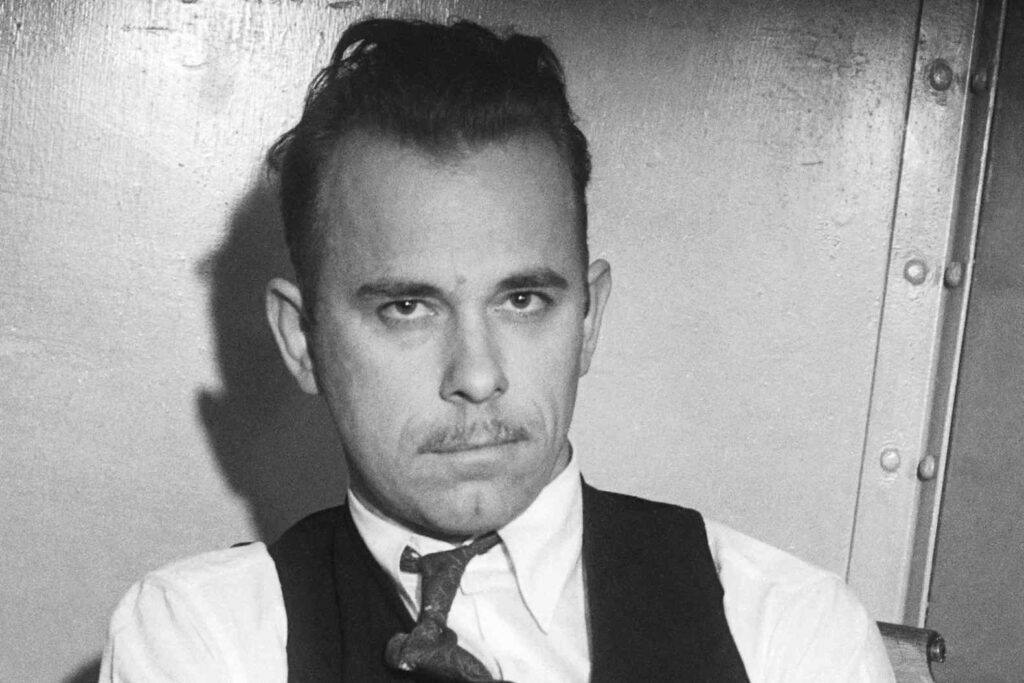
What do you think of when you hear the name John Dillinger? Perhaps you recall him as a depression-era bank robber and total badass gangster. Or maybe his name conjures up an image of him being shot to death by men from the Bureau of Investigations (what the FBI was before they added the “F”) as he came out of the Biograph Theater in Chicago.
Chances are; the last thing you would think about is that Dillinger left a cache of treasures, somewhere in Ohio. At least, that’s what some people try to claim.
The Dillinger Gang
This is not the time nor the place to give a full history of the Dillinger Gang (and all the crimes we know they committed), but there are a few things we need to know.
John Herbert Dillinger was born in Indianapolis on June 22, 1903. Even as a child, he developed a troublesome history. He was known to bully his classmates in school before he dropped out and took a job at a machine shop. At least in part because of his behavioral issues, the family moved out of the big city, settling in Mooresville, Indiana, thinking a more rural community would help. They quickly discovered it did not.
Dillinger joined the United States Navy in 1923 and was assigned to the USS Utah, which only last a few months after he deserted his ship in Boston and was dishonorably discharged. Back in Mooresville, he married a nice young lady named Beryl Ethel Hovious, and by most accounts, he really did try to settle down and at least curb his criminal tendencies. The problem was, it was all but impossible to find a job as nobody wanted to hire anyone with his history.
He, and a friend (and former convict) named Ed Singleton began planning some robberies. Before they could carry one out, he was arrested for assault, and this was the final straw that broke the camel’s back for Beryl who promptly filed for divorce.
Beryl’s leaving seemed to hurt him more than anything else. He no longer had any desire to try and become a productive member of society. Instead, he decided he was going to do his own thing – society be damned.
Not long after the divorce, Dillinger and Singleton robbed a Mooresville grocery store; however, a few things went wrong. First, he hit a woman over the head with a rifle, which discharged, even if the bullet never hit any marks. Secondly, one of the witnesses knew exactly who he and Singleton were, and he told the police. So, of course the two men were arrested.
Singleton pleaded not guilty, but Dillinger’s father (who was now a prominent deacon at the Mooresville church) spoke with prosecutor and worked out a very lenient sentence if Dillinger should confess. He did, but the judge issued a much harsher sentence than anybody was expecting.
John Dillinger decided that if they didn’t want to play fair – neither would he. If they wanted to paint him as a career criminal, he would become the “meanest bastard” of them all.
Thanks to his father’s influence, he was released from the Indiana State Prison early, although ten years after his conviction. The US was now in the middle of the Great Depression, in which even those with squeaky clean records could barely find employment, it was no surprise to anyone when Dillinger returned to a life of crime.
Now, however, things were going to be … well, different.
This time, he had amassed a gang, for lack of a better word, who would not only help him carry out his bank robberies, but they would also meticulously look at past crimes, learn what went right and what failed, look at new technologies at the time (such as using bullet proof vests and the latest types of machine guns) and now, they thought, nothing could stop them.
From 1933 to 1934, The Dillinger Gang robbed nearly a dozen banks (a couple of them more than once). Between robberies, they would hide in various locations, including Chicago, various spots in Ohio and Indiana and Wisconsin, even as far away as Arizona.
This lasted until that fateful night in Chicago when, after being betrayed by a certain Brothel madam, a group of agents shot and killed Dillinger outside the Biograph Theater.
And the Dillinger Gang was no more.
The Bailey Stash
Other than John Dillinger himself, it is believed that the Dillinger Gang had ten other members, mostd (if not all) of whom were also career criminals. Some names, such as Baby Face Nelson and Harry (Pete to his friends) Pierpont were notable names on their own already anyway. (We’ll get back to Pete Pierpont in a moment.)
Beyond the gang members, there were also others who assisted and supported the members in various ways, such as providing temporary hiding spots. Most of these people likewise were skirting the laws, such as running brothels or illegal gambling halls or speakeasies. Not exactly the kind of establishment that records all customer activities.
To further complicate matters, Dillinger (as well as his other associates) also used a series of alieses while traveling or hiding out. And, as soon as they felt authorities knew one alias, they’d stop using it and start using a different one.
This is just part of the reason why it is nearly impossible to compile a complete list of everyone Dillinger knew, where all we went, or even to know definitively which bank robberies he was responsible for. So … while some guy named Jimmy Lawrence robbed a bank in one place, and Carl T Hellman robbed a bank somewhere else, it took quite a bit of time before either of those places realized it was the same person, and that person was born John Dillinger.
Today, we believe we have figured out all of Dillinger’s aliases, but we also have to admit that it is possible we do not. Likewise, we think we know all the places where Dillinger (and his gang) hung out between robberies, but there’s still a big chance we do not. Let’s just say that there are parts of the DIllinger story we may never know, for certain.
According to some people, sometime in 1933, it’s possible that Dillinger may have robbed a bank in Jackson, Ohio. After the heist, he retreated to a farm approximately ten miles north of town which might have been (maybe) owned by a man named Bailey.
For many people, that’s too many “ifs”. If Dillinger robbed the bank … If Dillinger knew someone who lived north of Jackson … If that person’s name was “Bailey” and not some alias … if … if … if.
How To Be A Depression Era Bank Robber
It’s the 1930s in Midwestern America, and you just robbed a bank. Now what are you going to do? (If, that is, you managed to get away without getting shot or apprehended by the authorities.)
The first thing you want to do is hide. Clearly, the authorities know that you’re somewhere in the area and if they can find you – they’ll get their money back and send you to prison. So … hopefully this is something you’ve already thought about and have a plan – some place you can lay low for a short time while everyone is looking for you. (Thank goodness this is the 1930s and not today where you have a zillion security cameras per square mile, perhaps a slight exaggeration, that can track your every move.
Your best bet is to elicit help. Someone who not only can hide you should the authorities come looking, but who you trust can give them false leads, or if nothing else, convince them that they haven’t seen you in a very long time.
The second thing you’re probably going to want to do is figure out what to do with all that money. Your only bet is to hide it somewhere. If you’ve robbed a bank, the last thing you want is to be seen with a huge stash of cash, and let’s face it, if the cops do find you and you have all that cash on you, you’re never going to see it again. So, all that bank robbery stuff would have been for nothing.
But, where to hide it? You can’t exactly convert it to bitcoin because that won’t be invented for a very long time. You don’t really want to give it to someone because they might decide it was theirs, and even if there is honor amongst thieves, you still might lose some or all of it.
The only real choice you have is to dig a hole. That can’t be just anywhere. It has to be someplace only you know about … and not the kind of place some dude might start digging – nor do you want to choose any place where some dude might accidentally dig it up, or get curious why the ground at this particular spot looks different than the dirt around it … nobody ever said robbing banks was going to be easy.
The other thing to remember is that if you do get caught, and your loot is safely tucked away somewhere nobody will ever find it – it should, hopefully, still be there when you get out of (or escape) prison.
The Dillinger Gang Problem
While we may not know with any degree of certainty just how many banks (and other places) the Dillinger Gang robbed – we do know that he stole a ton of money. More money than anyone would even be able to spend over a two-year period. Therefore, we must assume that some of the Dillinger Loot never made it out of their hiding places.
If only we knew where those hiding places were.
So, when your criminal mastermind gets shot to death outside of a theater in Chicago … what’s going to happen to all that stolen loot?
That’s exactly what a lot of people want to know.
One of the more pervasive theories involves one of his gang members, Pete Pieroint. We now know that Dillinger hid out on Pete’s farm from time to time, including shortly before his demise (and after robbing a nearby bank) so … chances are he hid that money somewhere on that property.
But … where?
Well, that’s where Pete Pierpont comes into the picture.
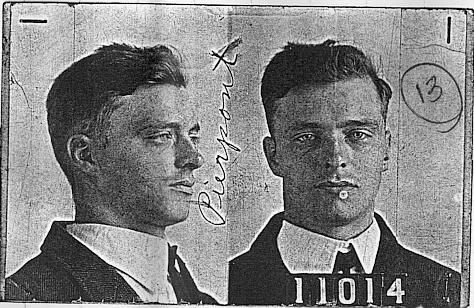
Pete had already accrued a massive criminal history by the time he first met Dillinger. By massive, I mean multiple counts of everything from robbery to assault and battery with intent to murder, even a prison escape or two, too. Of the Dillinger gang, Pete was probably the most … um … experienced criminal. So much so that Pete kind of took John under his wing, so to speak, often acting more like a mentor than a co-conspirator or friend.
Throughout the 1930s, Pete (or his family, rather) owned a farm near Leipsic, Ohio. And, as we would later learn, it was exactly the kind of place criminals could (and would) go to hide.
Shortly before his fatal encounter with Bureau of Investigation agents in Chicago, Dillinger and Pierpont (and a few others) had robbed a bank and fled to the Pierpont farm for a little game of Let’s Play Hard to Find. While he was there, he stashed the money … somewhere, most likely in a hole in the ground (some say it was near a well that, supposedly, still exists today.
A Stash of cash that Dillinger was never able to go back for…
…that makes a lot of people think is still there.
Is Dillinger’s Loot Still Somewhere On Pierpont’s Old Farm?
According to some people’s logic, since we have no record that someone collected the stolen money, then yes – it has to still be there. Someone would have boasted that they recovered it, had they actually done so as apparently outlaws are notorious braggers.
Honestly, there’s no way to prove it one way or another until someone finds it.
The current owners of that property (and the well, which I hear is still there) kind of like the notoriety that comes with owning land that once hid outlaws. Over the years, he’s granted television crews rights to shoot on his property, he’s been interviewed several times by various forms of news media, although the last thing he wants is for someone to come along and start digging around his property and making a complete mess of things.
But, if we take a step back, maybe we can see the issue with a little more clarity.
First off, any loot that would have been stuck there would have most certainly been paper money and the chances of it surviving just shy of a hundred years is probably less than zero.
Secondly, Dillinger and Pierpont were not the only two people who knew about the money, or where it was hidden. One of either Pierpont’s gang members, or members of the Dillinger Gang could have easily went to retrieve it without telling anyone.
Third – over the years, several people ahve attempted to search the property to no avail. It is possible one of them found something and refused to comment on it publicly as chances are they wouldn’t have been allowed to keep it.
A few of those searchers did find things other than a cache of stolen bank bills, some of which did contribute to what we know about both Pierpont and Dillinger.
My Verdict
Here’s what I think.
If the cash was buried at some point by Dillinger, Pierpont, or … anybody … I highly doubt that it would still be there today. While today we have types of plastics and other materials that could survive being bureied for an extended period of time – in the 1930s, nothing like that existed. By now, any wood containers would have completely disintegrated a long time ago. Anything metal would have rusted and fallen apart. Any bills left to the elements would, likewise, have deteriorated.
In other words – anything stuck in the ground nearly a decade ago would have rotted away by now.
But …
That doesn’t mean that there isn’t something that does remain that could be of some historic value.
The former Pierpont Farm is private property, so I sincerely hope that nobody reading this gets the idea to venture onto that land with a shovel and look for themselves. In this day and age, that’s likely to get you shot … or arrested. The landowners have stated they don’t want any holes dug in their land and everyone just needs to respect that.
Still, I hope that maybe someday (maybe) someone will find something that, if nothing else, will help solidify the story of Pierpont and Dillinger. But, until (if) that day arrives, it’s still interesting to look at this slice of history and maybe learn a thing or two.