
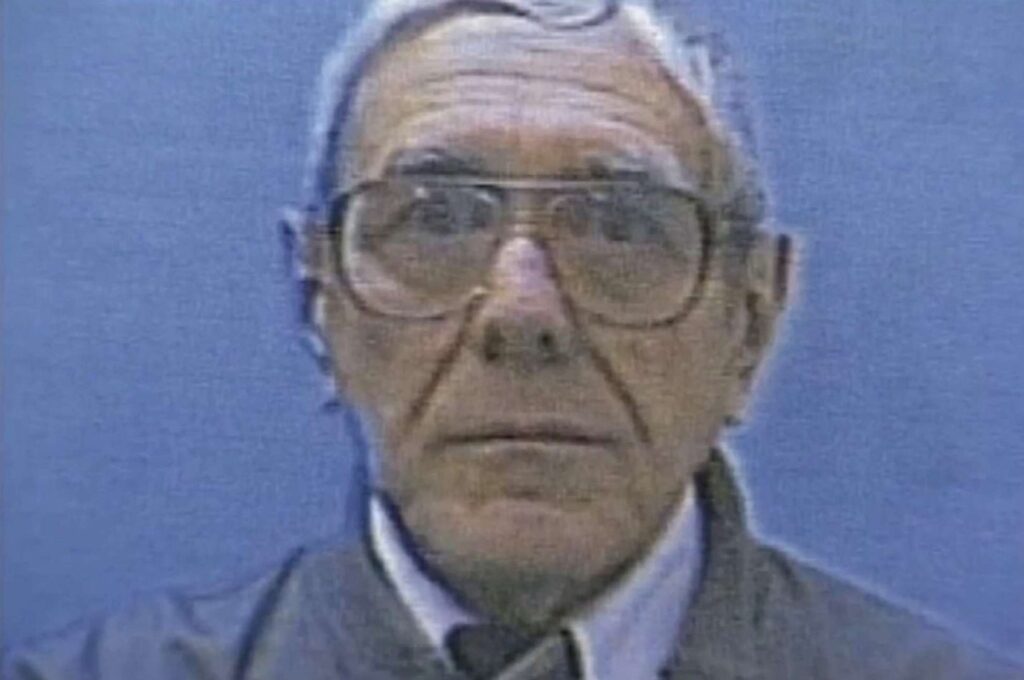
Here is what we know, for certain. On July 30, 2002, police in Eastlake, Ohio (a short distance north-east of Cleveland) made a gruesome discovery – a man’s body lay on the floor of his apartment, dead from a self-inflicted gunshot wound. He’d been diseased for about a week. The days counting down to his suicide were clearly marked on his calendar.
During the initial investigation, detectives learned that the man had recently diagnosed with an advanced form of colon cancer, leading them to speculate that this was the reason he unalived himself. The man also had around $82,000 in a bank account and all of his emergency contacts were coworkers.
They believed that the man’s name was Joseph Newton Chandler III because that’s the name he called himself, the name on the lease to his apartment, the name on his paystubs and bank accounts, and …
There was just one small, tiny problem.
As the police started to dig into Joseph Newton Chandler’s life, trying to locate a next of kin or some other family member, they learned that when he was eight years old, he, along with both his parents, were killed when their car collided head-on with a truck in Sherman, Texas. The family had been traveling from their home in Tulsa, Oklahoma to visit Joseph’s grandparents in Weatherford, Texas for Christmas.
Um … that can’t be right, can it?
Suddenly, The Mystery Deepens
Up to this point, everything had been relatively routine, as far as this kind of thing goes. When looking at Joseph’s life, nothing seemed amiss. Detectives found no clues to even suggest that even the smallest detail was out of place. The man appeared to be a shy, quiet man, living simply, rarely going out or trying to make friends.
There was no doubt that Joseph Newton Chandler III died when he was eighteen years old. So, then who was this other Joseph Newton Chandler III … and why did he steal the poor kid’s identity?
Genetic Genealogy
For years, the true identity of the man who claimed to be Joseph Newton Chandler III remained a mystery and lots of people tried to speculate, usually without any supporting evidence whatsoever.
For example, people began to speculate that Joseph was a serial killer, hiding his true identity to elude justice. He did, ever so slightly, resemble some of the sketches made of The Zodiac Killer so some people wanted to think that was him. Another possibility that was thrown out involved Joseph being some kind of gangster, either one with connections within the Cleveland Mafia or perhaps from somewhere else, sent to Cleveland to hide out for however long necessary.
The police did not have many leads to follow. For example, by the time the body had been found, advanced decay made things like processing fingerprints impossible. All financial and legal records associated with the man went to his false identity, so that would be no help at all. DNA was collected, but without another sample to compare them with, that wasn’t going to do detectives all that much good. But that was about to change.
Thanks to advancement in forensic genetic genealogy, by 2018 police had a new tool they could use to help identification – a large database of genetic genealogical information with the ability to match relatives, not just individual samples. So, when detectives compared this guy’s DNA with this system, they came up with a familial match they believed could have been the man’s son. Once detectives made contact with the son, they learned that his father, Robert Ivan Nichols, had been missing for some time. They were able to get a DNA sample from something that belonged to Robert and this provided a complete match to the man claiming to be Joseph Newton Chandler III.
Who Was Robert Nichols?
So, if the dead guy wasn’t Joseph – then … who was Robert?
Robert was born on September 12, 1926 in Albany, Indiana. He seems to have lived a mostly unremarkable life, until he joined the US Navy during World War II, serving aboard the USS Aaron Ward. This ship was bombed by the Japanese in waters just off Okinawa Island, wounding Robert, sending shrapnel into his back and ultimately earning him The Purple Heart. As soon as Robert came home, he burned his uniforms in a symbolic gesture to deal with the horrors of war he experienced.
Two years later, he married a lovely lady named Laverne and the couple began to grow their family with the first of three boys. During all this time, he worked as a Draftsman for General Electric.
Laverne and Robert got divorced in 1964, and this is where his story starts to get a wee bit mysterious.
After the divorce, he wrote to his mother saying that he had moved to Dearborn, Michigan where he worked in the automobile industry.
The following year, he sent two letters, about a month apart, to two of his sons. In the first, he said that he had moved to Richmond, California. A month later, he wrote another son saying he was residing in Napa, California. Neither letter contained much more information, and that was the last anyone from the family had heard from him.
For reference, back then Napa and Richmond were at least an hour’s drive away. Close – but not that close.
According to the IRS, Richard’s employment file was active until it came to an abrupt end in 1976.
Two years later, in Rapid City, South Dakota, someone who we now know was Richard, applied for a social security card claiming to be Joseph Newton Chandler III. That person then moved to Cleveland and used that to get identification and soon began working at the Edko, an engineering firm. Sometime later, he began working for Lubrizol as an engineer in Wickliffe, Ohio, another suburb of Cleveland.
While he was working, he claimed his emergency contact was his sister, Mary Wilson – however the address did not physically exist, and the number was not operational.
When interviewed by the police, the US Marshall’s office, or any of the journalists writing stories on this situation, Joseph aka Robert was described as a very quiet, unassuming man. There were, however, a few events that the newspapers seemed to enjoy talking about.
The first was about a Halloween party he attended in 1992 where he got dressed up as a gangster (think, flashy dark blue pinstripe suit like you saw in just about every 1980s mafia movie). What got people talking was that normally Joseph/Robert would decline invitations to social events, but this time he went. Also, his quiet, shy nature had been replaced with a personality that seemed to crave a bit of the limelight. According to two people, it was weird because he wouldn’t shut up.
Another story that supposedly came from multiple sources is Joseph/Robert admitting that he had once driven all the way from Cleveland to somewhere in Maine, just to go to an L. L. Bean store, however when he couldn’t find a parking spot, he just returned home without setting foot in the store.
Many stories pointed out various eccentricities sucn as his penchant for listening to white noise machines, or that time he (allegedly) had to go to the Emergency Room with lacerations on his penis caused by a solo sex act with a vacuum cleaner.
Weather any of these stories are true … that … well, you know.
The Big Question
The big question that seems to be on everyone’s mind is … why?
Why would Robert Nichols leave his life behind and become Joseph Chandler?
The most obvious answer, or at least the most common answer, (although nobody knows for sure) is that Robert was hiding from … something … someone?
Yet, with all the people that tried to answer this question, nobody has found any evidence pointing to what exactly that might be. Law enforcement found no crimes even remotely associated with the man, nor was he a possible suspect in any crimes.
Nobody has been able to tie him to any criminal organizations, although the possibility of his disappearance and assuming another identity to be somehow mafia related. What evidence supports this? Well … that’s hard to say. Cleveland is, historically speaking, always been a hotbed of mafia activity, although that hardly proves anything. Other people point out the Halloween party he attended, acting unusually extrovertedly, and looking like he stepped out of an 80s mafia movie.
Others have claimed that it could be the result of something that happened in the years following his divorce, when he cut off all communication with his children and possibly relocated to California, and-or South Dakota. This part of his life is still, largely, undocumented, so perhaps something did happen. Some, like the US Marshall investigating his assumed identity, believed he might have been involved in some sort of criminal activity – but if this was something he knew, rather than suspected, he would have said more.
Based on all the evidence that is currently (publicly) available – we are nowhere close to knowing.
Another possibility that has been raised is that this was a result of a mental health issue. While I can say this might be a possibility, I don’t think that it is. While Robert aka Joseph did display some weird behavior, there is nothing that presents as mentally ill. Also, the ability to locate a young man who had died before a social security card had ever been issued, then using that to create a new identity takes a certain level of organized thinking skills that often are not present during mental health episodes.
The Heart of the Story
The one aspect of this case that everyone seems to focus on is how Nichols stole the identity of a diseased eight-year-old boy and lived as him for the rest of his life.
One of the problems I’ve seen is that people try to reason this fact using modern perspectives. Today, we have countless systems in place that make doing this all but impossible – from computerized birth and death records that can be searched when someone tries to get an ID … DNA technology that can prove or disprove familial connections … not to mention all the electronic databases out there that can provide anyone with access to them your complete work history, what products you buy in stores, all recent addresses and telephone numbers, what you watch on television and I’ll stop there even though I think we all know I can go on forever because someone is going to get paranoid that someone out there knows how many times he streamed Bridgerton when he told his wife he was watching Game of Thrones because he doesn’t want anyone to know he’s an emotional softie and not the alpha male type he tries to convince people he is.
What many people fail to notice is that in the 1970s, it really wasn’t all that hard to assume someone else’s identity. Social Security numbers weren’t used at all to track children, so many kids didn’t know their numbers, and many had never requested their social security card.
All someone needed to do was to show up at a Social Security office with a copy of a birth certificate (which anyone could request from the correct state office) … and to get an ID, all you needed was a copy of your birth certificate and social security card … maybe a piece of mail addressed to who you want to be to prove that was your address ….
The only way you would get caught was if someone else tried to use the same identity, so if the person you were trying to become died at a very young age – it was almost a fool-proof plan.
There is no way to know exactly how many people did this exact thing, but it was known to happen. For example, this was a common technique used by certain abused women’s safe houses to protect women from violent abusers and give them a new life somewhere safe.
My Theory Based on All Available Evidence
There is no shortage of theories of what is going on here, and why Nichols became Chandler. Stealing someone’s identity is a criminal act, so therefore, the reasons why must be criminal in nature, too.
My main problem with this is that criminals tend to … well, be criminals. If our guy was someone like The Zodiac Killer (or really any of the other serial killers that people have suggested) surely there would have been something somewhere pointing to his guilt and other than some vague similarities in appearance. Also bear in mind that some of the people who saw Zodiac thought he looked completely different than other witnesses – and, presumably, they were looking at the same person.
There was nothing in this guy’s past to even suggest that he had any kind of criminal thing going on. Serial killers tend to have something on their criminal records, something that (at least in retrospect) can help paint a picture. We don’t see anything like that, here – although that is hardly proof of anything.
There are also certain things we tend to see with mafia, or criminal gangs – even if many of them appear to be somewhat racist by today’s standard. (No, I’m not suggesting that every person in the mafia is Italian or anything – just that criminal groups are just that, groups – and each group has some connection between its members.)
There is one thing here that is often overlooked because on the surface, it doesn’t explain much, but I’m wondering if that’s actually the key that explains it all.
Nichols served in the military, was wounded, then came home with a purple heart. He got married, tried to start a family … and this was exactly what a lot of young men at the time did as that was what society, or perhaps their families, expected of them. Many young men joined the military because Uncle Sam would pay for their college degrees if they didn’t qualify (or want to apply) for scholarships. Military Service was occasionally offered as an alternative to prison time for some criminal offenders. Sometimes, parents who didn’t feel their sons were living up to certain expectations would force them to join the military. Especially during this time period – there was no real way of knowing why he chose to serve his country.
Whatever – the point is we don’t know his mindset, or his reasons for joining the military. However, many people in engineering joined the military for the GI Bill or military experience.
What we do know is that Nichols was disillusioned after fighting in WWII – enough so that he burned his uniform. This suggests one of two possibilities. (Or a third being both.) First, it could mean that Nichols was emotionally sensitive. That wasn’t rare for people in this time, and any experience in combat (let alone your ship being hit with a bomb that left enough metal inside you that you were awarded the purple heart).
The other possibility was that Nichols suffered from a condition we now call PTSD or Post Traumatic Stress Disorder – but back in those days we referred to it as being “Shell Shocked” and needless to say we didn’t understand how it worked, nor how to deal with and treat it.
Let’s pause for a moment and look at one other factor that could be important.
After his military experience, he got married and started a family. This marriage did not last long and while I have spent a few hours trying to find divorce records, I have so far been unable to find any. Knowing this could provide a valuable clue (or maybe not – hard to tell).
It easily could have been something to do with his PTSD (if he did have that). People with PTSD can be triggered without notice, and that may cause him to do things that might not be healthy for children to witness. Therefore, divorce and separation from the family (which is exactly what happened) is entirely understandable.)
Let’s throw another idea out and see where this lands. (I am not suggesting that this is the case, just wondering if it is possible – I have seen no direct evidence to suggest this might be true.)
What if Robert was homosexual. That could (again, I’m not suggesting he was, just looking at possibilities) explain his desire to separate himself from social situations, that could explain his relatively short marriage (if he was trying to be not-gay – or trying to blend in with mainstream society – that’s what a lot of men and women did back then) … that could explain his sensitive nature. And If people started to find out about his sexuality (if he was gay) that might even explain why he wanted to become someone else.
My Thoughts on a Final Solution
Is it possible that Robert aka Joseph was a criminal of some kind? Perhaps even a murderer or at least someone who did something terrible and then went into hiding … what I think is that he just wanted to be a private person. He wanted to live his life, go to work, come home, eat dinner, spend his free time doing whatever he wanted, by himself. And if that is what someone truly wants, then I think that’s what they should do.
Not knowing the solution to this puzzle can easily lead us down as many false paths as we might want to take, just on the off chance that one of them may, someday, pan out. Yet, without any direct evidence of involvement in anything nefarious – I say let the man stay as the private individual he seemingly wanted to be.
After his death, when detectives got in touch with his biological children – his eldest son told newspaper reporters that nobody in the family felt any animosity toward the guy. Whatever the guy had done or whoever he was inside – the family wasn’t threatened by him, they didn’t have any issues with him either.
Just maybe – that should be the point here.
As far as we know, he never hurt anybody, or did anything bad (well, other than stealing some dead child’s identity) … so until we know that he did something bad – maybe we ought to just let the poor guy rest in peace.
Pingback: Who Killed Amy Mihaljevic - The Ohio Project