In 1856, “escape slave trials” were a relatively common event. Except to those involved, people rarely paid much attention to them. Yet, that year, one would prove to be different. Laws would be challenged. Procedures would be questioned. And, in a way, slavery itself would be put on trial. All because of one slave, a woman named Margaret Garner.
Garner’s Escape from Slavery
Margaret Garner, a mulatto, was born into slavery and belonged to the Gaines family of Boone County.
The Gaines were a relatively prominent family in the area at the time. Abner Gaines was a well-respected schoolteacher, tavern owner, and planter. He also had thirteen children with his wife Susan. Their eldest son gained notoriety as a postmaster. Another son gained his fame as paymaster for the Army, based at Fort Smith in Arkansas. In fact, many of the Gaines clan had impressive military careers.
Yet, the way they treated their slaves, on the other hand, was about far from the Disney version of the south that you can get. Treating slaves with violence was a common occurrence, even if it wasn’t spoken about all that frequently.
Margaret Garner had a large scar on her face and all she would say about it was that a white guy had given it to her, implying but not explicitly saying it was one of the Garner family.
Another odd fact that several historians and genealogists have pointed out was that each of Margaret’s four children were born about three months after Susan Gaines’s children were. The implication was that since Susan was unable to engage in sexual activities with her husband, he went looking for that satisfaction with Margaret, and we must assume, his other slaves.
On January 28, 1856, Margaret Garner, her husband Robert, and their four children escaped the plantation and crossed the icy Ohio river to what they hoped would be freedom. (Most reports say there was a total of seventeen people in their escape party, though.)
Margaret and her family made their way to Joe Kite’s place because he was her uncle and had offered to aid them, while others in their party found other safe houses on the Underground Railroad. Kite went to go see another abolitionist, asking for advice, but a small group of slave hunters found Margaret Garner before he could return. Before she, or anyone else for that matter, knew what was happening, they had the house surrounded.
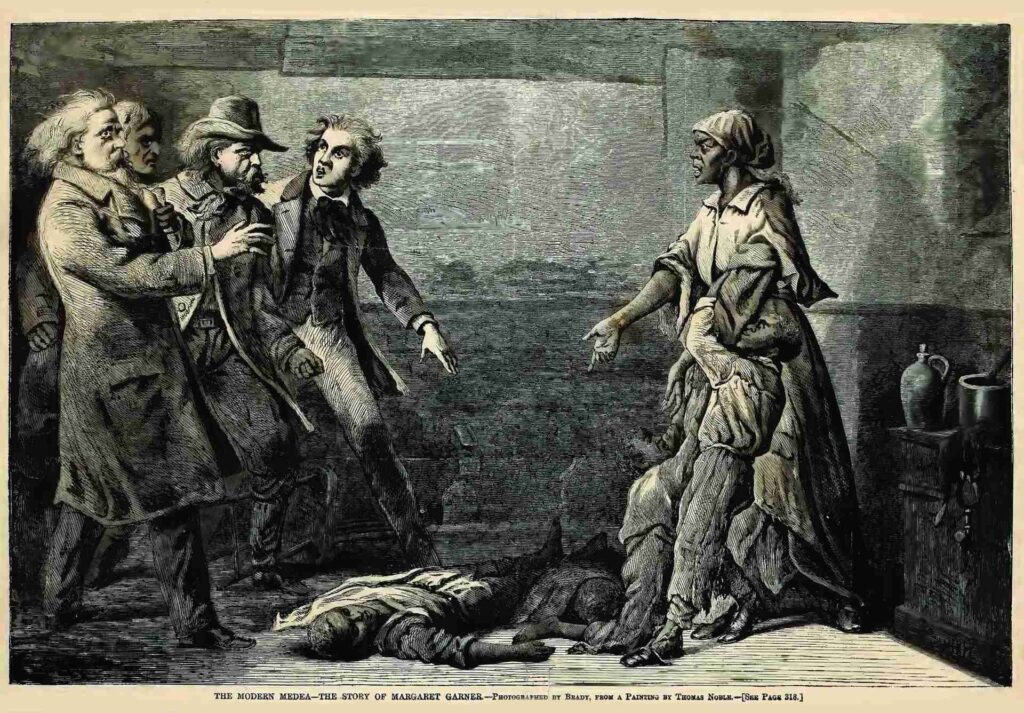
What Margaret did next shocked the world. Devastated at being caught this close to freedom, she knew that if she was caught and was forced to return to the plantation, she would be severely punished, as would her children, and they would be forced back into slavery, probably with even worse conditions than before. Death, she believed, was going to be her only way out.
Margaret’s plan was to kill all four of her children, and then herself if that proved to be the only way that she could escape the horrors of being a slave. When the slave hunters broke into Kite’s home, she had already murdered her youngest child and was preparing to unalive the next when she was stopped by the small mob.
She and what family she had with her were arrested. The question became … Now what?
Trial
Under normal circumstances, the trial for an escape slave would barely take a day. But for Margaret Garner … trial lasted several weeks. The problem was that both sides (the prosecution and the defense) had a vastly different plan for what they wanted to come next.
The prosecution wanted the case to be handled like an escape slave situation, becuase that was how they saw it. This meant that Garner would be returned to Kentucky and would face trial and punishment there.
But to Garner and her lawyers, they wanted Garner to be tried for the murder of her daughter. The Ohio Governor at the time had already informed them that should Margaret be convicted, he would instantly pardon her and allow her to escape to freedom.
Part of the legal questions that needed to be answered was whether or not Margaret Garner should be considered a “person”. By the letter of the law, if she was a persson, then she should be tried in Ohio for murder. If she was not a person, then she would be returned to the south and tried as an escaped slave.
The trial lasted over two weeks and the judge in the case deliberated for a couple more before he ultimately decided that Margaret Garner be returned to Kentucky.
What Happened to Margaret Garner?
Records show that Margaret was returned to Kentucky and was convicted as a runaway slave and was returned to the plantation. Further records show that nearly a year later, she was sold and shipped off to Louisiana, probably to prevent her from trying to escape ever again.
What records do not indicate is what sort of punishment she faced once she was returned to her “owner”.
The following year Louisiana was subject to a wave of Typhoid Fever, and Robert is on the record saying that she fell victim to the plague and died sometime that year.
Garner’s Legacy
In 1987, Toni Morrison published her novel “Beloved!” which the author said is mostly based on the story of Margaret Garner. Several years later, in 2005, Morrison wrote the libretto for the opera Margaret Garner, co-commissioned by the Michigan Opera Theatre, Cincinnati Opera and Opera Philadelphia which premiered in Detroit.