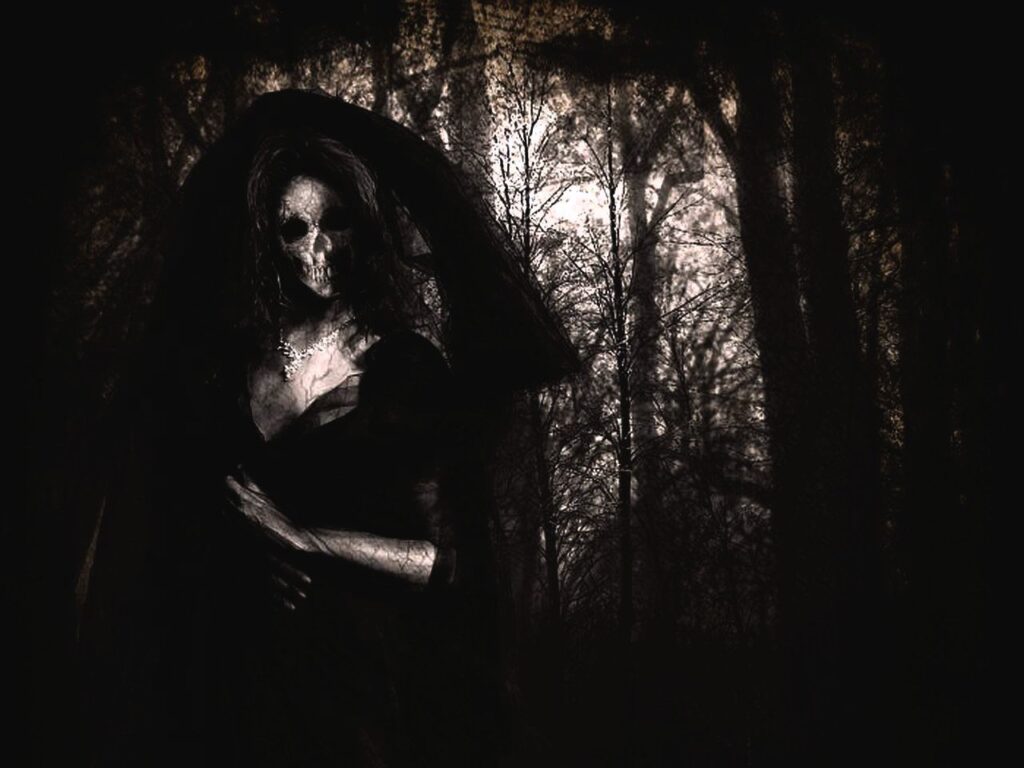
The mysterious Woman in Black first appeared in the mid 1800s, roaming the streets of Victorian England, leaving frightened men, women, and children in her wake. Soon, it became clear that she could not stay still, as similar ghostly apparitions began to appear throughout Europe, Asia, and all the Americas – including Ohio, but we’ll get to that in a moment.
Who … or What was this mysterious figure?
That may depend on who you asked.
Many at the time were quick to associate her with death, at least indirectly, as many who claimed to have seen her were soon to have lost a loved one. In Latin America, she was known as La Llorona, or The Crying Woman – and legend has it that after she discovered her husband was unfaithful, went into a rage and killed all her children and has since roamed the world in ghostly form, appearing shortly before a child was to die.
Several of the Asian regions have similar stories, such as the one where a mother sent her children out to fish on the sea before a storm and after they failed to return home, she felt such guilt that she has forever roamed the countryside, an omen of death.
Everywhere you go, it seems, they have a different version of this Woman in Black. Usually they say she’s some kind of ghost, sometimes little more than just a shadowy figure. In nearly all the legends, she is somehow associated with death. Some may say she appears to collect the souls of the soon-to-be departed. Others want to say she’s out for revenge. Some say she appears as an ominous warning.
Modern historians have pointed out that the Woman in Black originating in the Victorian times may be an important clue as Death was pretty much everywhere as medicine was rather barbaric, we didn’t understand how illnesses or diseases were transmitted, and looking back it’s hard to see why the death rate wasn’t any higher than it already was.
Many cultures also required widows to adhere to certain customs, such as wearing veiled or shrouded black dresses like what the legends say the Woman in Black wore. This leads some historians to believe that many (if not Most) sightings were little more than mourning ladies seen at a distance. Practical jokes were kind of common as well, so there’s that, too.
It is worth nothing that since 1983, there has been a renewed interest in the Woman in Black, and we can blame a single person for that: Susan Hill. That was the year she first published her novel The Woman in Black, which someone later made an award-winning play of, and they seem to make a new movie version every few years.
Massillon Ohio – Late 1800s to Early 1900s
Today, the city of Massillon, Ohio boasts a population of nearly 32,000 individuals. Although, in 1890 around the time this story starts, the population was a bit closer to 10,000.
The earliest mention we can find of the Massillon Woman in Black comes from the September 5, 1895, edition of The Independent (the local newspaper) that broadly exclaimed that “Charles Richter is the latest victim of the Plum Street ghost.”
These words highly suggest that Richter was not the first to see the ghostly apparition, however no details of earlier sightings remain.
The article details how Richter saw the apparition, a woman dressed all in black with an unusually small head, as he was returning home one evening. Frightened, he first started walking faster, then had to alter his route home. It wasn’t until he was safely back at home that he could finally utter a sigh of relief as the apparition was no longer chasing him. After this, Richter always tried to return home at an earlier hour, or else he would take an alternate route.
A second tale was told involving two young men, Peter Ertle and James Myers, Jr., as well as an unidentified young lady. The three were standing on the corner of Prospect and Plum streets, engaged in a lively discussion when what appeared to be a woman in a black veiled dress began to hover nearby. Upon further examination (one of the men (Ertle) was considering having harsh words with her about eavesdropping when he decided that the woman’s outfit was “of another generation” and noticed her head appeared to be about the size of his fist. Before either man could do anything, the figured seemed to float away toward Cedar Street. At a “gingerly” pace, they followed the figure who led them on a labyrinthine path until they had lost sight of it. At that point, they returned to the street corner and resumed their conversation.
A short while later, the ” same woman, man or spirit “appeared again. Ertle stated that as the three of them were facing different directions, one of them would have seen the woman approach, but none of them did. It was as if the figure had just appeared near them. As the men turned to face the woman in black, she began to drift away as she had done before.
After this, the three finished their conversations and went their separate ways, vowing never to stop and speak again at that intersection.
Ertle would say that he believed the figure to be a woman, one “afflicted with some malady of the head”. Myers, the article mentions, was of the belief that “the figure ghost of the orthodox variety” – the article further expands that idea saying that several members of his family had notable experiences with ghostly apparitions.
Ghost Hunters
When we hear the tern “ghost hunter”, we usually think of something a lot more modern than something from the late nineteenth century. Chances are we think of some ‘reality’ television show where people go into supposedly haunted locations with an assortment of gadgets in order to … well, it depends on the show.
Yet, while researching this article, I was surprised to discover that “Ghost Hunting” was a thing, even back in the 1800s. I would have to say, though, that without all those modern gadgets, it must have looked quite different.
In some ways, it was a chaotic mess.
For some, ghost hunting meant grabbing your nearest firearm and heading to some (supposedly) haunted location because I guess even the dead can be killed by a bullet. For others, it meant the development of groups like the UK’s Society for Psychical Research (SPR) which was established in 1882 and researched supernatural phenomena like mediumship, haunted houses, and (I’m not kidding) hypnosis. (Yes, at one point, they believed that hypnosis was a supernatural phenomenon.)
Between the 1840s and the 1920s was also the era of The Spiritual Movement when practitioners would routinely hold seances in attempt to reach the dead, or would have adventures in the astral or spiritual realm, or where topics like mesmerism and hypnosis were explored. While some arguments can still be made today for some of what was going on, this period is generally looked upon unfavorably due to the high number of fraudsters and charlatans taking advantage of people’s beliefs in order to make a quick (or a slow) buck.
So … Back to Ohio…
The Independent (newspaper) some days after telling the story of Ertle and Myers account of the woman in black, note that “Henry Ryder shot a ghost consisting of Frank Webb and William Conrad Saturday night” when a group of men had gone out ghost hunting along Prospect Street. Turns out both men shot were okay. One went home and fainted while the other went to the doctor to have a small metal ball removed from his arm. The paper did try to admonish the ghost hunters, asking them to make sure they were shooting ghosts, not innocent men or some practical joker.
As it turns out, the ghost was real, but not supernatural. Webb had been sitting on Conrad’s shoulders as the two of them were wrapped in some sort of black cloth and somehow did manage to scare quite a few young ladies who thought the ghost looked very realistic.
The paper noted that sightings of the woman in black, among other ghostly apparitions, continued to be the talk of the town for quite some time. And so, it seems, did the practical jokers.
I Swear This Isn’t An Episode Of Scooby-Doo
The Mystery of the Massillon Woman In Black would, believe it or not, be solved by a small group of meddling kids. Just kidding – it was The Massillon Independent.
As more and more tales of the Woman in Black continued to be talked about, the staff at The Independent knew that there had to be some kind of rational explanation, although they admit the possibility of there being a supernatural explanation as well. They didnt’ care – they just wanted answers.
So they did what peopel did at the time and offered a reward to anyone who could solve the mystery once and for all. Those funds were soon paid out to a man named B.J. Graybill.
The Woman in Black was, he helped to discover, a young lady identified as one Mrs. Libold, from Canton (the next town over) who was over her head in debt. After being hounded and chased by debt collectors, she got the inspiration for the Ghost Story.
Essentially, by day, she’d be around town selling her Catholic prayer books to the town’s faithful, but by night she’d appear as The Woman in Black, hoping to frighten the very same people who she believed would run to her to purchase one or more of her prayer books. She claimed (and once the proverbial cat was proverbially out of the proverbial bag) and people seemed to believe her – that it all started as an innocent mistake when she had missed the last train home while visiting friends in Massillon.
She put on her costume (for lack of a better word) near the intersection of Prospect and Plum when she was spotted by a couple of people having a discussion. When they moved to approach her, she fled out of fear, taking a winding path through town until she finally made her escape. They spotted her again a short while later, and once again she took off as fast as she could although this time the men did not follow.
Over time, as she would come into town and visit friends, she would make the ghost appear thinking that it would better her chances of selling her books, and she really did not see the harm in what she was doing.
After being found out, Mrs. Libold promised not to be The Woman in Black anymore. And as far as we can tell – she kept her word.
She would have gotten away with it if it weren’t for those meddling … ok, enough Scooby references.
A NOTE FOR HISTORICAL ACCURACY:
If you were to look at a modern map of Massillon, Ohio you might notice that streets like Prospect and Plum and Cedar are nowhere to be found. But, before you dismiss this story as some kind of hoax, I should probably mention that the town has, on several occasions, changed street names. Plum is now called Federal Avenue. Prospect is now known as 4th Street and Cedar is currently 5th.