
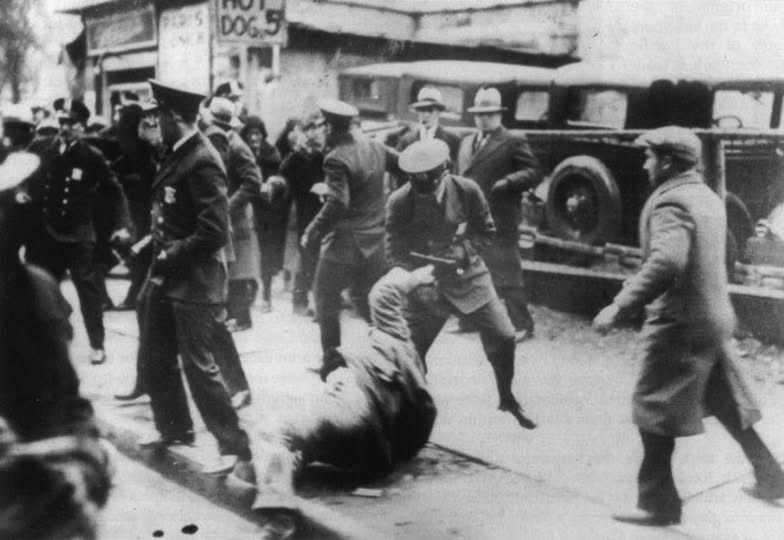
The year was 1934, and The Great Depression had a devastating impact on the entire nation. Yet, some locations, like Toledo, seemed to feel the pain worse than others. There was record breaking levels of unemployment and for the working-class citizens, life seemed bleak. Working conditions suffered, becoming more miserable than they ever had before.
This was especially true for one Toledo Factory, Auto-Lite, that made automobile parts.
On April 12, 1934, a thousand workers walked off the job and began picketing. The working conditions at the plant had become unbearable; they complained that they could not support their families, and for months their complaints had gone unanswered.
The Auto-Lite managers, unfazed, just hired more workers.
Throughout The Great Depression, similar strikes were happening all over the USA, but this one was going to be different.
Soon, the thousandss who had walked off were joined by others. Some were unemployed men who could relate. Others saw the wrong in mistreating workers and put the blame on bankers and business owners trying to capitalize on their workers.
It would not take long before this strike became the talk of the town … and then the nation.
Then, two people would die, six would get arrested, and hundreds would be injured. To understand what happened, we first need to head back to the founding of this great nation.
A Brief History of Labor Unions
Some people may think that Labor Unions are a relatively modern invention, but the first labor union in the United States, the Federal Society of Journeymen Cordwainers began in 1794. A little over a decade earlier, a group of journeyman tailors had gone on strike to protest wage decreases, but there was no organized union for them to join.
As the eighteenth century was coming to a close, the new nation was flooded with new European immigrants, many of whom were so desperate for gainful employment that they were willing to work any job, no matter how much (okay, how little) they would be paid. So, when a bunch of shoe workers lost their jobs only because their employers had found people willing to work for a lot less, a group of them banded together to create America’s first union.
By the time the Civil War was over (and that whole Slavery thing was over) most American cities had a variety of trade and skilled Unions. Memberships in these unions were usually limited to white, Protestant males, since they were among the only demographics that could afford not only the monthly or yearly dues, but could also contribute to the various Strike Funds. Women were not allowed to work, Blacks and recent immigrants were excluded because established workers feared they’d be willing to work for less wages, nor did they have the established capitol to contribute much.
Slowly, though, this would change. Some industries, such as ship builders, soon got Black Labor Unions as those industries relied more heavily on black workers. In 1867, The National Union for Cigar Makers began to accept women after a few Women’s Unions had been formed to protect lady dress makers or mill workers.
After the The Federation of Organized Trades and Labor Unions was formed in 1881, and the American Federation of Labor in 1886, the US Congress was all but forced to create the US Department of Labor in 1913. The following year saw the passage of the Clayton Antitrust Act that allowed unions to strike and boycott establishments.
Around this time, many unions were starting to lose popularity, and the anti-union movement began to ramp up. In some ways, the working conditions had improved (partly thanks to the Unions) and with immigration slowing on its own, many employers (and politicians) made the argument that they were no longer needed.
The great depression, however, demonstrated that unions were still needed to protect American workers as business owners tried to capitalize on the financial situation. Some industry leaders were making record profits while the workforce, in general, was suffering worse than they ever had, which they didn’t think was fair.
By the 1930s, the argument for or against Unions was pretty much the same as it is today. Workers wanted to be treated fairly. Businesses were in the business of making money. I guess somethings never change.
Auto-Lite
The Federal Labor Union #18384 was set up a little bit differently than other unions, primarily in the way that its members were employed by one of three companies, Auto-Life, the Bingham Stamping and Tool Company, and Logan Gear Company, which were subsidiaries of Auto-Lite but also the Spicer Manufacturing Company which was not.
The union had been threatening to strike for a short while as its members were complaining about working conditions getting worse. The United States president, Franklin D. Roosevelt, tried a bunch of things to calm tensions. He believed that the auto industry was an important factor in rebuilding America following The Great Depression and that a strike of this nature would cause a setback greater than he was willing to accept. It’s hard to say how much good Roosevelt’s influence did.
On February 23, 1934 the Auto-Lite workers voted to strike asking for a ten percent wage increase. This strike lasted a few days before the company agreed to a five percent wage increase and promised to continue negotiations, which management later refused. Therefore a new strike was agreed upon, however a much smaller number of workers walked off the job.
Those strikers were soon joined at the picket line by members of the American Workers Party, as well as members of other unions, and even many who were simply unemployed. AWP’s plan was to surround the entire building with as many supporters as possible in a massive show of solidarity. Auto-Lite management petitioned the local government to now allow any more than twenty-five picketers at each location, and the courts granted an injunction instructing the union on the new restriction.
This did not go over well with the other unions, nor with various union supporters, who vowed to show up anyway. So, the local authorities issued warnings, trying to shut the whole thing down completely.
When picketing began on May 7th, there were four picketers. The two organizers were arrested and released the following day without being changed. Later that day, the picketers were back (40 this time) all of whom were promptly arrested. Every day, labor organizers sent between 30 and 60 picketers to the Auto-Lite plant, most of whom were promptly arrested. During each court appearance, the American Workers Party tried to fill the courtroom with supporters who would cheer and jeer at every decision. After a few days, all the picketers were released, and the trial was over even though no decision had been made.
Meanwhile, Auto-Lite was trying to break the strike themselves. They hired over a thousand non-Union workers willing to work at any pay rate; they purchased large amounts of tear gas and hired armed guards to protect the plants. They even hired members of the Sheriff’s Department to help (paid for by Auto-Lite).
For members of the American Workers Party, this was the final straw. They were done playing nice. It was now their goal to fill the streets with as many protesters and picketers as they could. On May 21st, they convinced over a thousand people to join the picket line. The following day, that number grew to over four thousand. By May 23, that number had reached over six thousand. And it kept growing.
The city police, already reduced in numbers due to financial cutbacks, were really starting to feel the pressure. And they were starting to sympathize with the picketers as they were likewise experiencing their pain.
When the crowd gathered to an estimated ten thousand, Lucan County Sheriff’s Department decided it was time to take action. THey came in and arrested five of the organizers. Then, a deputy started to beat an elderly gentleman protesting and picketing, after which all hell broke loose.
The crowd began to fight back, throwing whatever objects they could at the sheriffs. They, in turn, responded by turning water hoses on the picketers. But, as they were outnumbered, the crowd seized the hoses and turned them on the deputies. These deputies then were able to flee into the Auto-Life plant, the managers barricading them (and everyone already there) inside the building.
The sheriff deputies then headed up to the roof and began throwing tear and vomit gas canisters off the roof into the crowd below, mixing a cloud so noxious that even they began to get sick themselves.
Picketers retaliated against this by throwing things like rocks through the Auto-Lite windows, turning tires into makeshift slingshots. Then they started lighting trash on fire and hurling that through the broken windows.
That evening, a group of protesters attempted to break into the Auto-Lite building only to be met by police resistance. A few shots were fired, however only one person was (slightly) injured. Several more attempts were made to break in, however none were successful. It’s estimated that about twenty more people were (slightly) injured in the mele.
Bang!
The following day, tensions were just as high as ever when the decision was made to pull in the Ohio National Guard, which (like today) was made up mostly by teenagers. They were able to (mostly) clear a path through the picket line, but this did little to alter things, good or bad.
Later that afternoon, Roosevelt sent Charles Phelps Taft II (son of the former president) to Cleveland to act as something of a mediator.
Otherwise, things progressed mostly the same as they had the day before. Except, this time, the National Guard was there to handle things. This time, they were much quicker (and more frequently) with the tear and vomit gas, which by now the picketers were used to. The residents of the nearby communities, however, didn’t seem to enjoy throwing up on their lawns, so they began to complain, until one of the National Guard leaders was arrested for creating a public nuisance.
It is unclear if the National Guard got the order to stop using the gas, or if they simply ran out, but by late afternoon, they were throwing stones and bottles at the picketers, probably the same debris that had just been hurled at them.
Other local unions also began to get involved, too, at least when they weren’t expected at work.
The following day, Saturday, continued with more of the same. Troopers began arresting as many protesters as they dared, only to have them pay a small fine and be released a few hours later. This did not seem to apply to the Union leaders, who were arrested and held incommunicado, rendering union influence momentarily blind.
Finally, though, Taft was able to start some negotiations between Auto-Lite and the unions, and betwen them a deal was reached. Plant workers got their 10% raise but had to give up on some of their other demands. Both sides won some and lost some.
By Sunday afternoon, all the fighting had stopped, and streets had been cleared (of people, at least – there was probably still some garbage pickup left to do.)
During all the fighting, a handful of people had lost their lives causing many to look back and wonder why it had to happen in the first place.
Is It Over Now?
Even though the violence had died down and people went about their business, that doesn’t mean that the situation was over. Far from it – but at least Taft was getting both sides to sit down at the table and talk through their grievances.
Of course, both sides were still up to their old tricks. Auto-Lite tried to create their own union, ran and controlled by them, which didn’t go over very well. Union members tried to get everyone who had crossed the picket line fired, which wasn’t going to happen either.
The American Civil Liberties Union (ACLU) showed up and helped defend all the union guys who had been arrested.
Looking back, part of the problem was that there were no clearly designed rules for what was acceptable for Unions, what powers they held, and what unions or their members could (or could not) do.
It is also worth noting that many of the laws that are in effect today, a lot of the workplace standards and protections did not exist at that time, and it was the unions that did what little they could to protect their members. For example, there was no legal concept of workplace discrimination. There was no concept of an 8-Hour workday, or 40-Hour work week. (And overtime pay? Forget about that!)
Pingback: The Kent State Shootings - The Ohio Project