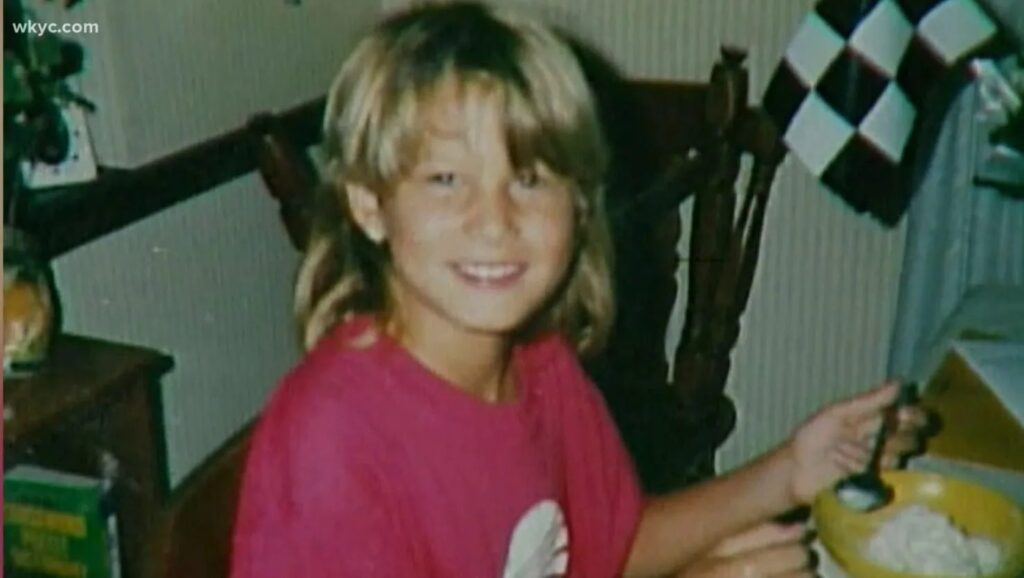
On December 11, 1978, a ten-year-old elementary school student named Amy Renee Mihaljevic was kidnapped in Bat Village, Ohio, a western suburb of Cleveland. On February 8, 1990, her lifeless remains would be found off a county highway somewhere about forty miles south of there. Police at that time had no suspects as news footage slowly told her story and children all across the state (and beyond) suddenly learned the lesson of Stranger Danger.
Since then, her story has been featured in numerous television shows, like America’s Most Wanted hosted by John Walsh, countless podcasts and true crime blogs. There has been no shortage of possible suspects, but to this date, the killer remains unknown.
What We Know
Shortly before that December 11th date, Amy took a telephone call from an unknown man who claimed to be a friend and coworker of her mother’s. He told the girl that he wanted to buy her mother a gift because she had just gotten a promotion at work and needed help picking out the perfect gift. Amy agreed to meet the man in a shopping center not far from her school after classes had let out for the day. The man also told Amy not to tell anybody – he didn’t want anything to ruin the surprise.
Thankfully, Amy did tell someone – her brother. And, she told her best friend. (Not that any of them convinced her not to meet up with an unknown complete stranger.) Later on, the police would learn of at least three other young girls who had also gotten similar phone calls, although it is possible there were still more.)
Amy walked with a friend to the shopping center where she was seen waiting outside an ice cream shop. Several minutes later, one of her classmates saw a young man approach, wearing a beige windbreaker, khaki pants and a button-up shirt. He whispers something to her, then puts his hand on her back and the two walk away.
At first, the Amy’s classmate thinks the man is Amy’s father, since she had never met the man or seen him around school. That notion would quickly change.
The following February 8th, Amy’d body would be found not far from County Road 1181 – along with at least some evidence, leading investigators to conclude that she had been killed shortly after her abduction. There was undigested food still in her stomach, some kind of soy-based meat substitute consistent with artifical chicken served at many Chinese restaurants at the time. (Also, not consistant with anything served at the girl’s school.) There were also some yellowish, perhaps gold colored fibers on the girl’s body that were not consistent with anything she was known to have owned or could have come into contact with.
What was missing were the boots Amy had been wearing at school that day, her demin backpack, some horse head shaped earrings, and the binder she used at school.
Detectives also collected some DNA at the scene. However, compared to today’s forensic toolkit, there wasn’t much they could do with it. Years later, though, that DNA would be put to good use.
The Investigation
Quite often in investigations like this, the police (and other authorities) know a lot more than the public. For example, there were numerous witnesses in this case, mostly school children, whom the police did not name. This was, in part, to protect their identities, but it was also to control what information the general public had access to.
There were other certain key details that the police kept from the public’s eye, some of which would be exposed by them later on.
I feel the need to state that this is completely normal with all sorts of investigations. It can help detectives sort out which tips they get are more or less reliable than others. Sometimes, evidence can point non-trained investigators in wrong directions, causing officials to waste time following up on things that ultimately go nowhere. All told, there are numerous benefits to doing this – and there is nothing strange about this in the slightest.
It should also be noted that several police detectives in several northeastern Ohio did everything they could to catch this girl’s killer, the FBI was involved, and I have seen nothing to suggest that any agencies dropped the ball or failed to do their due dilligence.
Many Years Go By
One of the FBI Agents assigned to the case was named Phil Torsney. He worked on the case with obsessive focus, at least until he retired. He quickly discovered that retirement didn’t ease his mind, so in 2013, he came out of retirement to focus on the case again.
At this time, Torsney told reporters that he believed that the girl was not killed in the Bay Village area, saying the community was too close-knit and keeping a murder silent would be near impossible. He believed that the girl was killed somewhere near where her body was found, suggesting that he had some connection to the area (in that he knew the area very well.)
A couple of years later, forensic DNA testing was done on the blanket found near the victim. Results suggested that it was covered in dog hair from Amy’s family pet. It was believed that this was used to help transport the girl after death.
And then, someone came onto the investigators radar … someone with a very bizarre story of his own. That man’s name was Robert Ivan Nichols, or Joseph Newton Chandler III – someone I recently wrote about right here.
Someone suggested that Nichols aka Chandler shared a vague resemblance to the man several people said they saw Amy meet outside the Ice Cream shop. He was within the possible age range, and while he lived on the opposite side of town, this was close enough to raise the detectives suspicions.
When Torsney and the Bay Village police chief met with Nichols/Chandler, they were quick to point out to journalists that they did not believe the man was a likely suspect, the police chief saying that if they didn’t follow all leads, they wouldn’t be doing their due diligence.
While we do not know what was talked about during that interview, we know that Torsney said that he would be a viable suspect if the man was not able to provide an alibi for that day. After the interview, he seems to have dropped off the FBI’s radar.
Shortly after this, the FBI’s funding for Torsney was running out. They allowed him to finish working for a short time to finish which leads he had been working on but soon the man went back to retirement yet again.
A Possible Suspect? Maybe? Um … Dunnow
Mihljevics’ murder, a lady called the police to offer a tip. She believed that the man she had been dating at the time was the guilty party. In a sworn affidavit, she claimed that when the girl was abducted, the two of them lived less than a mile away from the abduction spot. The man also had a niece who not only went to the same school as Amy, but the two were in the same grade.
The woman also reported that on the night Amy died, her ex had left the house, which she said was unlike him, and didn’t return until the following morning.
Detectives learned that the man occasionally traveled through the Ashland County area where the body was dumped. When they showed the man’s picture to several of the witnesses present at the time of the abduction, one commented that of all the pictures she had seen, he had the closest resemblance of them all. Detectives learned that thirty years ago, he owned a car that was very consistent with the one several witnesses had reported seeing.
The man turned himself into the local police station and for two days was interviewed by detectives. During those interviews, he made several statements the police thought were odd. For example, when asked if he had ever called the Mihaljevic’s phone, he stated that he might have, but only if he had dialed a wrong number. He also admitted that the year when Amy was abducted, he was going through what he called a “dark period” suggesting that he might not have been aware of everything he had done.
When asked if his DNA would be found on Amy’s body, he said that it would be if someone had planted it there.
On the second day, the police administered a polygraph test (which are highly unreliable which is why under most circumstances, they cannot be used in court) which they said shows “signs of deception”. At that time, the man’s DNA was also collected.
A search warrant was executed, during which the police were observed removing several boxes of evidence, although they did not comment on what was taken.
In the days (turned weeks) after the interview, the Bay Village police repeatedly saying they were still “following up on leads” and that if an arrest was warranted, it would be made.
The man is currently said to be homeless, but several journalists had managed to track him down easy enough. He refused to comment. His former girlfriend has also refused to talk with reporters.
And since then – the police aren’t saying much either.
(Author’s Note) If you would like more information about this case, there is a lot further information online. Also, there was a lot of information that I did not include in this article, as doing so would have easily taken the word count well into the six-digit range. If you do know something, please report it to any of the proper authorities.